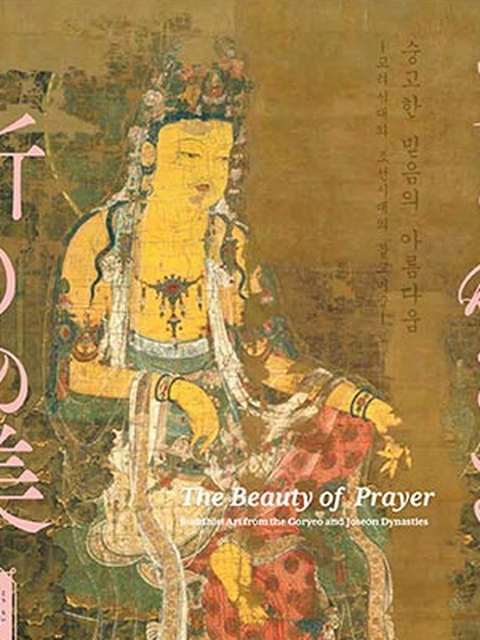
Detail from the exhibition image: Avalokiteśvara, the central figure of The Beauty of Prayer.
Exhibition review · Korean Buddhist art · Koryŏ and Chosŏn · 11th–16th centuries
うるわしき祈りの美
The Beauty of Prayer — Buddhist Art of the Koryŏ and Chosŏn Periods Kyushu National Museum · Dazaifu
Dates
5 September — 15 October 2023
Museum
Kyushu National Museum 九州国立博物館
City
Dazaifu · Fukuoka · Japan
Venue
Rooms 9 and 11 · Cultural Exchange Gallery
Period covered
11th — 16th century
Type
Focused exhibition · Korean Buddhist art
Central thread: showing how, despite radically different religious policies under Koryŏ and Chosŏn, Buddhist images and ritual objects continued to give visible form to prayer, salvation and sacred presence.
01 · Essential
Why see this exhibition?
The exhibition’s greatest strength is the concentration, in Japan, of Korean Buddhist works now dispersed among museums, temples and shrines. Its forty-eight catalogue entries range across paintings, sculpture, illuminated scriptures, bronzes, celadon and lacquer. Seen together, they reveal both the material breadth of Buddhist art on the peninsula and the importance of Japan as a major site of preservation for Korean cultural heritage.
The exhibition compares Koryŏ and Chosŏn without reducing them to a simple opposition between a Buddhist kingdom and a Confucian one. Koryŏ court patronage clearly supported Buddhism, while the Chosŏn state restricted its institutional power. Yet the production of images, scriptures and ritual objects continued. Prayer therefore provides a useful thread for tracing Buddhist continuity across political rupture.
楊柳観音像 — Willow-Branch Avalokiteśvara, Koryŏ, 1310, Kagami-jinja, Saga. Its monumental scale and pictorial refinement epitomize Koryŏ court Buddhist painting.
02 · Curatorial
What is the exhibition’s argument?
Rather than telling a purely dynastic history, the exhibition places belief at the center. The uses of works, their devotional efficacy and the continuity of religious practices connect Koryŏ and Chosŏn more effectively than chronology alone.
Compare two religious regimes.Koryŏ and Chosŏn adopted very different policies toward Buddhism, but Buddhist artistic production did not vanish with dynastic change.
Move beyond painting.Famous Koryŏ paintings are set among sculpture, scriptures, ritual bronzes, celadon and lacquer.
Study circulation.The present location of so many works in Japan foregrounds transfer, donation, collecting, temples and maritime networks.
Return objects to prayer.An image is not only a composition to admire; it is a support for contemplation, intercession, ritual and salvation.
03 · Visit
Route and exhibition design
Installed in two rooms of the Cultural Exchange Gallery, the show operates as a concentrated study display rather than a large retrospective. This scale encourages close comparison between media. Painting remains central, but it is repeatedly brought into dialogue with sculpture, liturgical objects and sacred texts.
地蔵菩薩遊戯坐像, Koryŏ, 11th century, cast and gilded bronze, Kyushu National Museum.
Images of salvation.Amitābha, Avalokiteśvara, Kṣitigarbha and Buddhist assemblies show the visual forms taken by hopes for salvation in medieval Korean painting.
Scripture and merit.Copied and printed sūtras, sometimes written in gold, show that producing sacred text was itself a devotional and merit-making act.
Sculpted presence.Koryŏ bronzes create a more tactile and volumetric relation to sacred images.
Objects for ritual.Incense burners, water vessels, celadon and lacquer reveal the material environment within which Buddhist images functioned.
04 · Selection
Works and objects to remember
楊柳観音像 — Willow-Branch Avalokiteśvara
1310 · Koryŏ · painting on silk · Kagami-jinja, Saga · Important Cultural Property
At more than four meters high, this is one of the monuments of Koryŏ Buddhist painting. The museum emphasizes its collective production by court painters on a single enormous silk support. Transparent veils, jewelry and textile patterns combine material splendor with Avalokiteśvara’s compassionate presence.
地蔵菩薩遊戯坐像 — Kṣitigarbha in a relaxed seated pose
11th century · Koryŏ · cast and gilded bronze · Kyushu National Museum · total height 49.2 cm
This sculpture condenses another quality of Koryŏ art: a calm, approachable sacred presence created through relaxed posture and a gentle expression. Its small scale encourages close viewing, in marked contrast with monumental hanging paintings.
梵字宝相華草文銀象嵌香炉 — Incense burner with Sanskrit characters and floral scrolls
14th century · Koryŏ · bronze with silver inlay · Nara National Museum
The object demonstrates how metalworking virtuosity served ritual. Sanskrit characters and silver floral scrolls animate the dark bronze surface as light changes. It also reminds us that Buddhist experience involved scent, gesture and spatial atmosphere as well as images.
05 · Knowledge
What the exhibition helps us understand
Koryŏ is more than painting.Bronzes, celadon, manuscripts and lacquer reveal a complete material system supporting Buddhist practice.
Chosŏn was not a Buddhist void.Despite restrictive policies, paintings and ritual objects continued to be produced in the fifteenth and sixteenth centuries.
Japan is a major site of preservation.The present dispersion of works is essential to any history of Korean Buddhist art and its circulation.
Prayer shapes form.Monumental scale, repeated Buddhas, gold, incense and the tactile presence of bronze all contribute to religious efficacy.
Importance for Buddhist art history
The exhibition places Korean works within a concrete East Asian geography. Political history, collecting, ritual materiality and maritime circulation become inseparable. For Koryŏ and early Chosŏn, this approach is especially productive because it shows that the history of forms is also a history of uses and movements.
06 · Documentation
Further reading
Catalogue: 九州国立博物館, うるわしき祈りの美 : 高麗・朝鮮時代の仏教美術, Dazaifu, Kyushu National Museum, 2023, 128 pp.
Object list: forty-eight entries spanning painting, sculpture, sūtras, bronze, celadon and lacquer, with rotations during the exhibition.
07 · Conclusion
Verdict
Assessment
Highly recommended for understanding Koryŏ and continuities into Chosŏn
うるわしき祈りの美 successfully places famous masterpieces beside less spectacular ritual objects without reducing Korean Buddhist art to a history of style. Its most important contribution is the relationship it establishes between beauty, materiality and devotional use.