인각사와 삼국유사 — 역사의 향기를 따라 천년의 숨결을 만나다

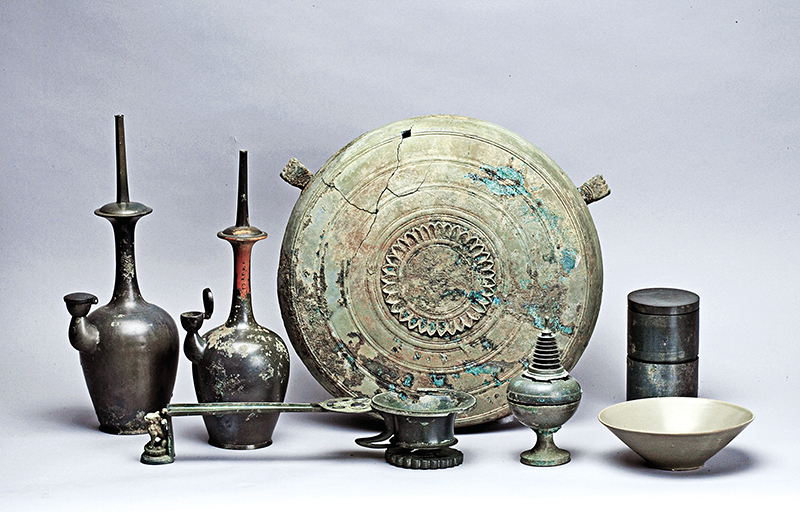
Buddhist ritual objects excavated at Ingaksa
Ritual metalwork excavated at Ingaksa, dating around the ninth century and first shown together after conservation.
Exhibition review · Buddhist archaeology · Koryŏ · Iryŏn · Samguk yusa

인각사와 삼국유사

Ingaksa and the Samguk yusa — Following the Fragrance of History, Encountering a Millennium of Memory
Central Buddhist Museum · Seoul

Dates
13 November 2013 — 12 January 2014
Museum
Central Buddhist Museum
City
Seoul · South Korea
Displayed
77 groups · 195 objects · 5 Treasures
Theme
Ingaksa · Iryŏn · archaeology · transmission of the Samguk yusa
Catalogue
271 pages · 2013
Central thread: how can the material history of a monastery, the life of a monk and the transmission of a foundational text be studied as one Buddhist heritage?
01 · Essential

Why this exhibition matters

The exhibition’s importance lies in refusing to treat the Samguk yusa as a disembodied book. It returns the text to Ingaksa, where Iryŏn spent his final years, and connects intellectual history with archaeological layers, ritual objects, inscriptions and old editions.

The 77 groups and 195 objects also included an exceptional ensemble of Buddhist metalwork recovered in the 2008–2009 excavation and shown together after conservation. These finds push Ingaksa’s history far back before Iryŏn and demonstrate the temple’s ritual importance in the ninth century.

Samguk yusa volumes 4 and 5 from Pŏmŏsa
Samguk yusa, volumes 4–5, preserved at Pŏmŏsa. By comparing editions, the exhibition made the material transmission of the text visible.
02 · Curatorial

What is the exhibition’s proposition?

The exhibition tells a three-dimensional history: an archaeological site, a monastic biography and a foundational text. None of these can fully explain Ingaksa on its own.

  • Start from the ground. Excavations from 1992 to 2009 revealed multiple phases of the temple and ninth-century ritual metalwork.
  • Place Iryŏn inside an institution. Ingaksa was his late-life residence but also a major Koryŏ Sŏn centre linked to assemblies of the Nine Mountains.
  • Show the Samguk yusa as a transmitted object. Surviving editions demonstrate that the text has its own material history.
  • Reconnect stories and images. Tan'gun, Ch'ŏyong, Thousand-Armed Avalokiteśvara and Queen Sŏndŏk become routes into the religious and visual culture preserved by the book.
03 · Visit

A four-part route

  1. The foundation of Ingaksa.The site, landscape, foundation traditions and excavation finds introduce a long ritual history.
  2. Iryŏn and Ingaksa’s rise.The thirteenth-century monk’s residence turned the monastery into an important Sŏn centre; his memorial stele documents this phase.
  3. Ingaksa, birthplace of the Samguk yusa.The book is presented as history, Buddhist memory and a repository of traditions excluded from official chronicles.
  4. Decline and restoration.The route follows Chosŏn restrictions, the 1597 destruction, later rebuilding and modern archaeological recovery.
Stupa and stele of National Preceptor Pokak at Ingaksa
Stupa and stele of Pokak kuksa Iryŏn. The damaged stele remains a crucial source for the monk’s final years.
04 · Selection

Objects to remember

Ingaksa ritual hoard

인각사 출토 공양구 일괄 — Ingaksa ritual hoard

c. 9th century · Buddhist metalwork · excavated 2008–2009

Incense burners, an incense box, a kundikā and related implements form an unusually coherent group. Their shared context helps reconstruct ritual use and technical exchange with Tang China.

Samguk yusa volumes 4–5

삼국유사 권4–5 — Samguk yusa, volumes 4–5

late Koryŏ / early Chosŏn · woodblock print · Pŏmŏsa

The paper, typography and traces of transmission make clear that the survival of the Samguk yusa depended on editions, copying and preservation.

Pokak kuksa memorial stele

인각사 보각국존 정조탑비 — Memorial stele of Pokak kuksa

Koryŏ · biographical inscription · Ingaksa

Composed by Min Chi and assembled from the calligraphy of Wang Xizhi, the stele records Iryŏn’s life and the Nine Mountains assemblies. Old rubbings are indispensable because the monument is now fragmentary.

Modern portrait of Iryŏn at Ingaksa

일연 — Iryŏn as a figure of memory

1206–1289 · Koryŏ monk · compiler of the Samguk yusa

The exhibition places Iryŏn within monastic networks, Sŏn institutions and the concrete life of Ingaksa, turning authorship into a history of religious practice and documentary culture.

05 · Knowledge

What the exhibition makes clear

  • The Samguk yusa is deeply Buddhist. Its historical value should not obscure the monastic culture that shaped its collection and structure.
  • Ingaksa predates Iryŏn’s memory. Archaeology reveals important ritual activity centuries earlier.
  • Archaeology changes art history. A hoard found in context can reconstruct uses that an isolated museum object cannot.
  • Transmission is itself historical. Broken steles, rubbings, old editions and modern restoration all show heritage surviving through transformation.
Why it matters for Buddhist art history

The exhibition’s strength is to make material and textual culture speak to each other. A monastery appears not simply as architecture but as a producer and transmitter of objects, inscriptions, biographies and stories.

06 · Documentation

Further reading

  • Official page: Central Buddhist Museum.
  • Catalogue: 불교중앙박물관, 인각사와 삼국유사 — 역사의 향기를 따라 천년의 숨결을 만나다, Seoul, 2013, 271 pp.
  • Catalogue essays: Ingaksa’s historical development; Iryŏn and the Samguk yusa; Buddhist metalwork excavated at Ingaksa; transcription and translation of the Pokak kuksa stele.
07 · Conclusion

Verdict

Assessment
An essential exhibition for thinking about place, text and object together

Ingaksa and the Samguk yusa goes beyond celebrating a classic text. It restores the book to its material environment: a monastery, ritual objects, inscriptions, religious networks, destruction and restoration. That integration is what makes the exhibition so valuable for Buddhist art history.