View of 조선의 승려 장인 at the National Museum of Korea, 2021. Photograph published by Beopbo News.
Exhibition review · Korean Buddhist art · Chosŏn · sculpture and painting
조선의 승려 장인
Monk Artisans of the Chosŏn Dynasty: Buddhist Sculptures and Paintings National Museum of Korea · Seoul
Exhibition dates
7 December 2021 — 6 March 2022
Museum
National Museum of Korea 국립중앙박물관
City
Seoul · South Korea
Curatorial team
Fine Arts Department · Kwŏn Kang-mi and the museum’s research team
Type
Temporary exhibition · Buddhist art
Central thread: understanding Chosŏn Buddhist art through the people who made it: monks who were simultaneously religious practitioners, specialized craftsmen, workshop leaders and transmitters of technique.
01 · Essential
Why see this exhibition?
This exhibition shifts the focus in a productive way. Rather than treating Chosŏn Buddhist statues and paintings as anonymous objects, it restores the people who designed, carved, painted, gilded and consecrated them. The museum brought together 145 groups or objects from twenty-seven institutions, including fifty-four works lent by fifteen monasteries. The exhibited works involve 366 identified monk artisans. This exceptional corpus makes it possible to understand Buddhist art as the result of collective labor organized through workshops and lineages of technical transmission.
Its historical importance is equally strong. The exhibition substantially complicates the familiar narrative of Buddhism simply declining under the Chosŏn dynasty. After the Japanese invasions of 1592–1598, Buddhist sculpture and painting instead entered a period of intense production. The growing numbers of chogaksŭng (조각승, monk sculptors) and hwasŭng (화승, monk painters) reveal a particularly dynamic Buddhist visual culture developing within monasteries.
Reconstruction of a workspace devoted to monk painters: the exhibition emphasizes gestures, tools and stages of production. Photograph published by Buddhist Journal.
02 · Curatorial
What is the exhibition’s argument?
The exhibition presents the monk artisan as a major key to understanding Chosŏn Buddhist art. His identity is double: he is both a religious practitioner and a highly specialized professional. The making of a cult image therefore becomes inseparable from monastic practice, collective organization of labor and the transmission of expertise.
Moving beyond anonymity.Names preserved in inscriptions, consecration records and colophons allow careers, lineages and workshop networks to be reconstructed.
Making production visible.Drawings, internal structures, materials, carving techniques and painting processes return the finished object to a concrete chain of operations.
Understanding collective work.Statues and paintings are rarely the work of one isolated individual: masters, assistants and disciples form mobile teams that are recomposed from one project to another.
Rethinking Buddhist Chosŏn.The intensity of production after the sixteenth century forces us to qualify the idea of Buddhism’s continuous disappearance under a Neo-Confucian monarchy.
03 · Visit
Route and exhibition design
The exhibition is organized in four parts. It begins by defining the monk artisan, then effectively opens the sculpture and painting workshops. The third section gathers major works as the material culmination of these practices, before a conclusion devoted to the memory of these artisans and their contemporary reinterpretation. This avoids a simple chronological sequence: the visitor moves from social identity to the gestures of making and finally to the cult images themselves.
A finished Buddhist painting placed alongside a preparatory drawing: a key display device for making visible the passage from sketch to cult image. Photograph published by Dong-A Ilbo.
승려 장인은 누구인가 — Who were the monk artisans?The first section distinguishes these specialized religious practitioners from lay craftsmen and shows the expansion of collective monastic production in late Chosŏn.
불상과 불화를 만든 공간 — Spaces of productionTwo “studios,” one for sculptors and one for painters, present tools, stages of manufacture, preparatory drawings and scientific examinations. CT images, in particular, provide access to the internal structure of wooden statues.
그들이 꿈꾼 세계 — The world they envisionedThe core of the exhibition brings together masterpieces by major monk artisans and shows how their expertise materialized the Pure Land, the Buddha’s assembly and the universe of the Avataṃsaka Sūtra.
승려 장인을 기억하며 — Remembering the monk artisansThe conclusion juxtaposes late Buddhist sculptures with a contemporary installation by the artist Vakki and asks how the memory of these artisan monks persists.
04 · Selection
Works and objects to remember
용문사 목각아미타여래설법상 — Wooden relief of Amitābha preaching, Yongmunsa
This work is one of the exhibition’s high points. Tanŭng transforms into three-dimensional relief a composition usually associated with altar painting: Amitābha sits at the center of a densely organized assembly. The object therefore blurs the boundary between Buddhist sculpture and painting. For the 2021 exhibition, it left its monastery for the first time since its creation 337 years earlier.
해인사 영산회상도 — Vulture Peak Assembly, Haeinsa
1729 · colors on silk · Haeinsa · Ŭigyŏm (義謙) and his workshop
This large painting of Śākyamuni preaching demonstrates a monastic workshop’s ability to organize a monumental and extremely crowded composition without losing visual hierarchy. Ŭigyŏm, a major figure in eighteenth-century Buddhist painting, appears less as an isolated artist than as the leader of a collective of specialized painters.
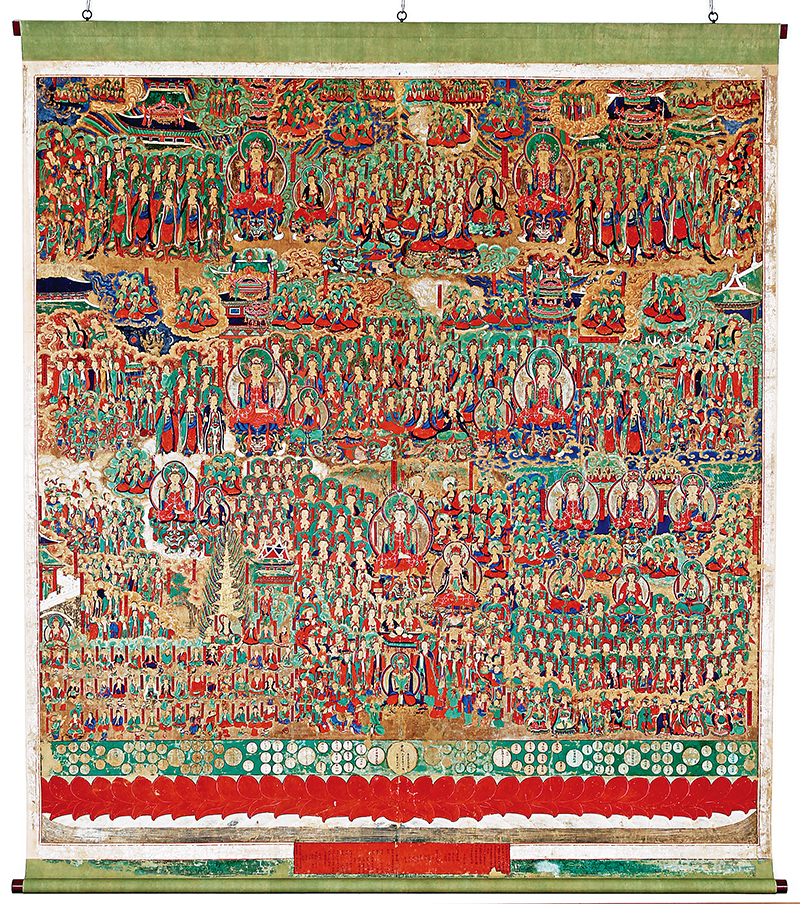
송광사 화엄경변상도 — Illustration of the Avataṃsaka Sūtra, Songgwangsa
1770 · colors on silk · Songgwangsa · Hwaryŏn (華蓮) and his workshop
The density of this painting makes the cosmological ambition of Hwaŏm art visible: several assemblies from the sūtra are distributed across a single surface saturated with figures, architecture and celestial spaces. The work shows how the virtuosity of monk painters served a religious and spatial problem: giving intelligible form to a potentially limitless doctrinal universe.
05 · Knowledge
What the exhibition helps us understand
The Buddhist image is a collective product.Inscriptions reveal teams organized around masters and disciples. Attributing a work to a single name therefore often obscures the actual reality of its production.
Workshops were mobile.Monk artisans moved from monastery to monastery. Their movements explain the circulation of models, techniques and iconographic solutions across the peninsula.
Technique participates in religion.Selecting wood, preparing a drawing, carving a cavity for consecration deposits, gilding or painting are not merely craft operations: they participate in transforming material into a cult presence.
Late Chosŏn was a period of invention.The museum notes that more than a thousand monk sculptors and about 2,400 monk painters from this period have now been identified, indicating the scale of Buddhist artistic activity.
Importance for Buddhist art history
The main methodological lesson is not to separate iconography from manufacture. A Buddhist statue or painting can be studied simultaneously as image, material object, workshop product, result of a monastic network and ritual support. The exhibition therefore offers an excellent model for a social and material history of Korean Buddhist art.
06 · Documentation
Further reading
Catalogue: 국립중앙박물관, 조선의 승려 장인, Seoul, National Museum of Korea, 2021, 400 pp.
Detailed catalogue: the volume notably develops the sculpture and painting workshops, mobile networks of monk artisans, production processes and the major masters of late Chosŏn.
07 · Conclusion
Verdict
Assessment
Essential for the history of Korean Buddhist art
The strength of 조선의 승려 장인 lies in making the producers of religious images visible. The masterpieces assembled are important, but the decisive contribution lies elsewhere: in reconstructing the workshops, collaborations, gestures and networks that made those works possible. The exhibition thus turns the study of Chosŏn Buddhist art into a history of practices as much as a history of forms.