
Bút Tháp, whose formal name is Ninh Phúc tự 寧福寺, is one of the most important surviving Buddhist architectural and sculptural ensembles of northern Vietnam. Its origins are traditionally traced to the Trần period, but the monastery seen today is above all the product of a major seventeenth-century reconstruction. That distinction matters: Bút Tháp is not simply a medieval foundation preserved unchanged, but a site in which an older sacred history was materially reshaped during the Lê Trung Hưng period.

The monastery became especially prominent in the seventeenth century under the Zen master Chuyết Chuyết (1590–1644), a major figure of the Lâm Tế lineage in Vietnam. After his abbacy, aristocratic patronage supported an ambitious rebuilding campaign. The surviving complex remains unusually coherent: a long axial sequence of gates, halls, courtyards, the bell tower, sanctuaries and rear buildings is enclosed and linked by extended corridors. The stone Bảo Nghiêm tower, associated with Chuyết Chuyết, gives the complex one of its most distinctive vertical accents.


The architecture is inseparable from sculpture. Carved timber, stone balustrades, altars, ritual furnishings and statuary create a dense visual environment in which seventeenth-century craftsmanship survives on an exceptional scale. The official heritage inventory records nearly one hundred statues. Among them are groups of Buddhas, Manjuśrī (Văn Thù) on the lion, Samantabhadra (Phổ Hiền) on the elephant, protective figures and portrait images.
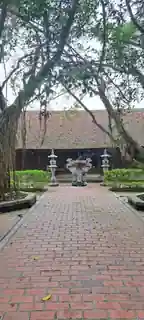
The long corridors and successive thresholds also change the way the images are encountered. Rather than being isolated as museum objects, sculptures appear within a sequence of ritual spaces, incense, dark timber interiors and controlled light. Bút Tháp therefore preserves not only individual masterpieces but also the spatial setting that gives them devotional meaning.
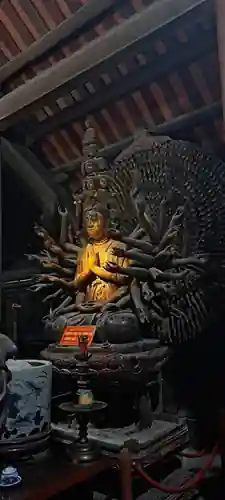
At the centre of Bút Tháp’s fame stands the monumental “Thousand-Armed and Thousand-Eyed” Quan Âm (Avalokiteśvara), completed in 1656 by the sculptor Trương Thọ Nam. About 3.7 metres high, the image combines a frontal, meditative body with an extraordinary radiating field of arms and eyes. Its technical ambition, iconographic complexity and exceptional state of preservation have made it one of the canonical masterpieces of Vietnamese wood sculpture; it is now recognized as a National Treasure.
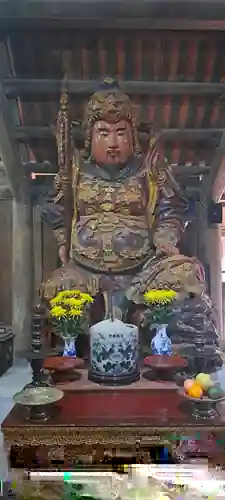
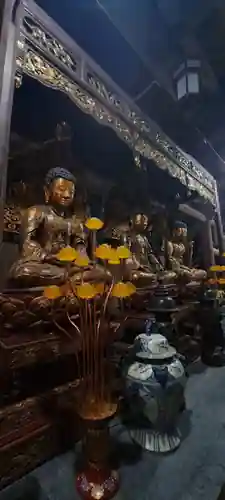
Seen together, the statues show the breadth of Bút Tháp’s visual programme. Calm Buddha images, dynamic guardians, bodhisattvas, portrait-like figures and elaborate devotional sculpture occupy the same complex. Their surfaces—gilded, lacquered, darkened by age or illuminated only intermittently—make clear how much the experience of Buddhist art depends on architecture and light.
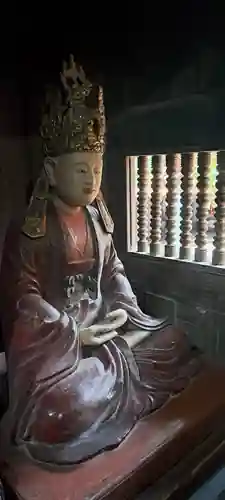


For the history of Buddhist art, Bút Tháp is therefore valuable on several levels at once: as a Trần-period foundation, as a major seventeenth-century Lê Trung Hưng reconstruction, as a centre associated with Chuyết Chuyết, and as a rare ensemble in which architecture, sculpture and ritual setting are still legible together. The site offers a concentrated view of the technical and devotional sophistication reached by Vietnamese Buddhist art in the seventeenth century.
Reference points
- Origins: Trần dynasty; later major seventeenth-century reconstruction.
- Location: Bút Tháp, Bắc Ninh, south bank of the Đuống River, Vietnam.
- Key figure: Zen master Chuyết Chuyết (1590–1644).
- Major work: Thousand-Armed and Thousand-Eyed Quan Âm, 1656, Trương Thọ Nam.
- Coordinates: approx. 21.06103° N, 106.02225° E.