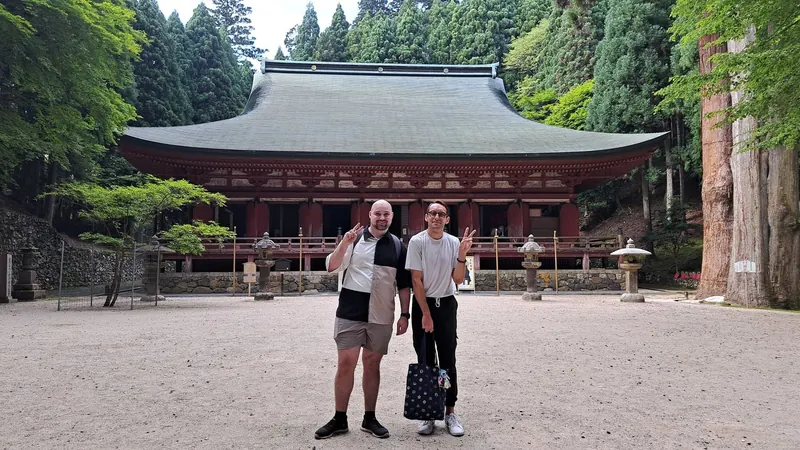
This was one of the highlights of my journey in Japan: a pilgrimage to Mount Hiei (比叡山) with a dear friend, a specialist in Japanese Buddhism and former university classmate, Guilhem Laude. I had known Hiei for years through texts and the history of Japanese Buddhism; walking through it gave the mountain an entirely different reality. It was no longer simply a name associated with Saichō and Tendai, but a topography of slopes, forests, distances and thresholds.
Rising above Kyoto and facing Lake Biwa, Mount Hiei is one of Japan’s great sacred landscapes. In 788 Saichō (最澄) established a retreat and place of practice here that became the nucleus of Enryaku-ji (延暦寺) and the centre from which Japanese Tendai (天台宗) developed. On site, that history becomes spatial. Enryaku-ji is not a single temple building but a mountain-wide institution, articulated through areas including Tōdō (東塔), Saitō (西塔) and Yokawa (横川), linked by paths and forest.
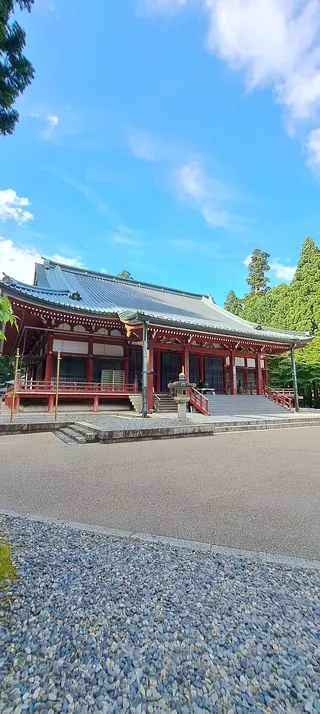
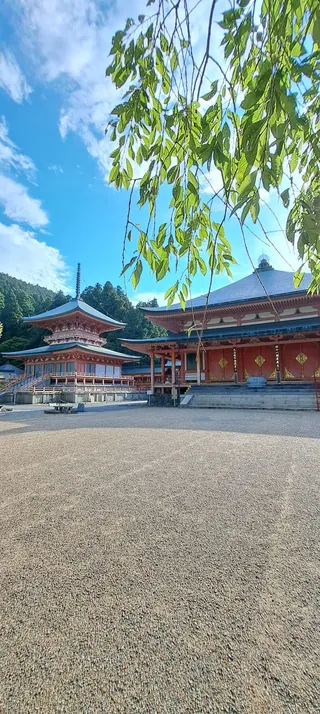
What interested me most was precisely this relationship between religious institution, architecture and landscape. Hiei shaped a remarkable part of medieval Japanese Buddhist history. Hōnen (法然), Shinran (親鸞), Dōgen (道元), Eisai (栄西) and Nichiren (日蓮) were all formed, in different ways, within this environment before their trajectories led them toward other forms of practice and teaching. Hiei is therefore not only a major Tendai centre; it is also one of the places from which the later diversification of Japanese Buddhism becomes intelligible.
As we moved through the mountain, I became increasingly aware of the rhythm imposed by the site. One does not simply move from one building to the next: one walks, climbs, descends and crosses stretches where the forest almost takes over. That sequence changes the way one looks. The monumental buildings matter, but so do the intervals between them. They help explain how an entire mountain can become a field of religious practice.
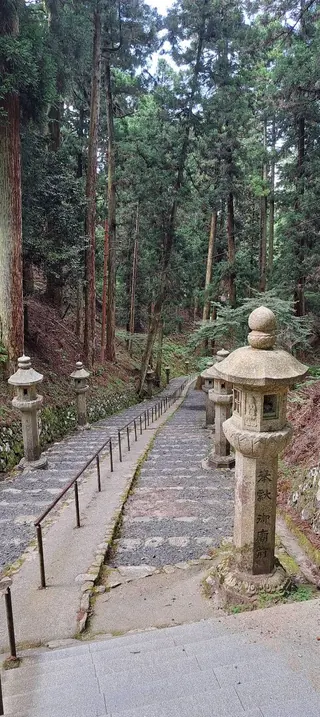
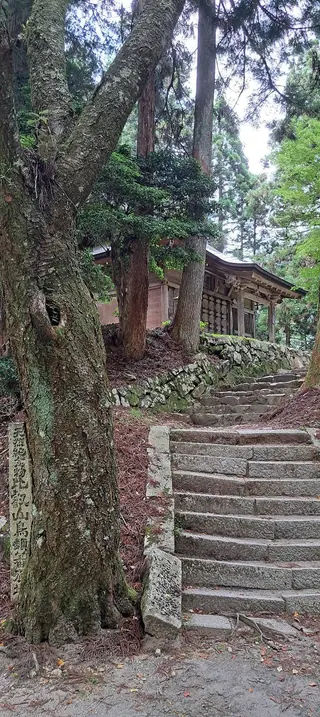
The old stone steps and lanterns were among the strongest images of the day. Their significance goes beyond the picturesque. They materialize movement repeated over centuries: monks, pilgrims and visitors, but also the everyday circulation connecting different monastic spaces. Walking these passages restores something that can disappear when Buddhist art history is reduced to buildings and objects alone.

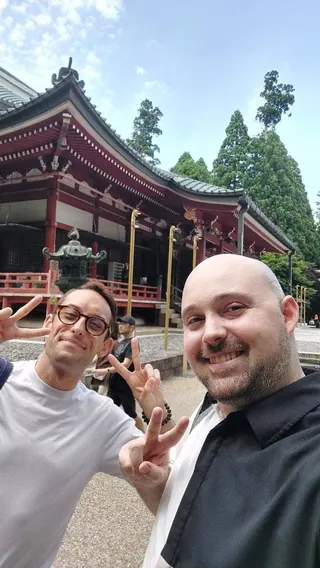
The experience also mattered because I shared it with Guilhem. Our discussions about Tendai history, monastic lineages, practice and spatial organization accompanied the walk. Visiting with someone whose knowledge of Japanese Buddhism is so deep changes the act of looking: an architectural detail, an orientation, a building name or a bend in the path can become a way into a much larger religious history.
The view toward Lake Biwa also makes clear that Hiei is not a closed world. Its position between Kyoto and the Otsu region gives the mountain an unusual geographical presence. Monastic retreat coexists here with a commanding position over the routes and landscapes around it. From above, that tension between withdrawal and connection becomes immediately visible.
I left Mount Hiei feeling that I understood more clearly what a “monastic mountain” can mean. Architecture does not operate alone here: it depends on paths, forest, distance, views, weather and the repetition of practice. Some places are beautiful because of their scenery; others because of the histories they preserve. Mount Hiei is both, and that is precisely what made the day so important to me.
Reference points
Place: Mount Hiei (比叡山), between Kyoto and Otsu.
Monastic centre: Enryaku-ji (延暦寺).
Foundation: 788, by Saichō (最澄).
Tradition: Tendai (天台宗).
Complex: Tōdō (東塔), Saitō (西塔) and Yokawa (横川) areas.
Heritage: Enryaku-ji is included in UNESCO’s Historic Monuments of Ancient Kyoto.