
Chùa Phật Tích, also known in historical sources as Vạn Phúc tự, is one of the major sites for the study of Buddhist art under the Lý dynasty. The sacred site probably has an earlier history, but it was under King Lý Thánh Tông that it acquired the scale of a major royal foundation. Epigraphic and archaeological evidence connects a large building campaign with 1057, the fourth year of the Long Thụy Thái Bình era.

Between 1057 and 1066 the royal complex was developed around a monumental tower. Bricks bearing the inscription “Lý gia đệ tam đế, Long Thụy Thái Bình tứ niên tạo” provide an exceptional chronological marker. Later tradition relates that when the tower collapsed it revealed a monolithic green-stone image of Amitābha that had once been gilded. Whatever the legendary dimension of that account, the surviving statue is securely a work of the eleventh century and one of the most important monuments of Lý sculpture.

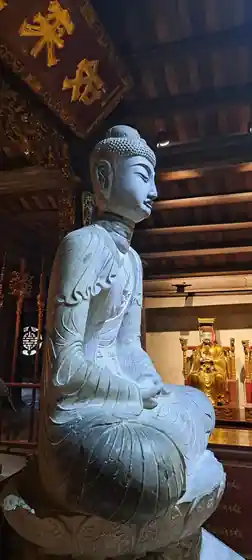
The Amitābha of Phật Tích is carved from a single block of green stone. The figure itself is about 1.87 metres high and reaches approximately 2.87 metres with its pedestal. Seated in meditation with the hands resting one upon the other, the Buddha has an elongated, calm body, a serene face and supple drapery. The pedestal, carved with lotus petals, dragons, clouds and water motifs, is inseparable from the composition.

Around the sanctuary, ten stone animals—lions, elephants, rhinoceroses, buffaloes and horses, arranged in pairs—also belong to the major corpus of Lý sculpture. Together with architectural and sculptural fragments recovered during twentieth-century excavations, they preserve something of the symbolic and ceremonial programme of the original complex.
Phật Tích also reveals the cosmopolitan character of Lý visual culture. Motifs such as kinnari and makara-like forms have been compared with Cham and wider Southeast Asian traditions. The Lý court did employ displaced and captive populations, including Cham people, in some royal projects after its wars with Champa. No surviving evidence, however, proves that Phật Tích itself was built by Cham slaves. It is more accurate to speak of artistic exchange, the circulation of forms and a political world in which artisans and displaced communities contributed to the material culture of Đại Việt.


The monastery was substantially rebuilt in 1686 under the Lê Trung Hưng and restored again in later periods. The older architecture no longer survives: the complex was almost entirely destroyed during the First Indochina War, with major destruction beginning in 1947, and rebuilding began in 1959. The buildings and tower visible today therefore belong to the reconstructed landscape of the monastery, not to the eleventh-century royal complex.


This stratification is precisely what makes Phật Tích so important. Beneath a largely modern architectural envelope survive eleventh-century sculptures that document one of the formative moments of Đại Việt Buddhist art. The Amitābha, the stone animals and the archaeological remains form an exceptional core around which later reconstructions, royal memories and contemporary pilgrimage practices have accumulated.
Reference points
- Major royal building campaign: 1057, under King Lý Thánh Tông.
- Monumental tower: developed in the 1057–1066 sequence; the Lý structure no longer survives.
- Major work: monolithic green-stone Amitābha, eleventh century.
- Sculptural ensemble: ten Lý-period stone animals arranged in pairs.
- Present site: largely reconstructed from 1959 onward after wartime destruction.
- Coordinates: approx. 21.09650° N, 106.02440° E.