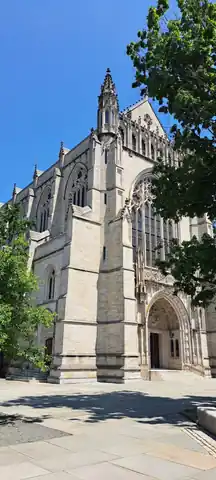
I had the honor of being selected to participate in the international conference Ritual and Materiality in Buddhism and Asian Religions at Princeton University. The conference itself took place from June 13 to 15, 2023, during a stay of roughly one week on campus. Only twenty doctoral students were selected from nearly ninety applications submitted from Asia, Europe, and North America. That competitive selection made the stay an especially significant moment in my doctoral training.
The program brought together twenty-one scholars, one keynote speaker, two discussants, and twenty invited doctoral students. It was hosted by the Princeton University Buddhist Studies Workshop and supported primarily by the Glorisun Global Buddhist Network, together with Princeton units including the Tang Center for East Asian Art, the Humanities Council, the Program in East Asian Studies, the Center for Culture, Society and Religion, and the Department of Religion. The aim was not simply to place case studies side by side, but to bring religious history, art history, philology, literary studies, and anthropology into conversation around a shared question: how do ritual practices take form through objects, images, texts, bodies, and spaces?
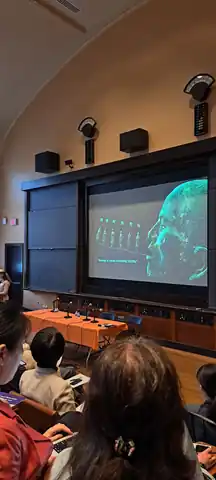
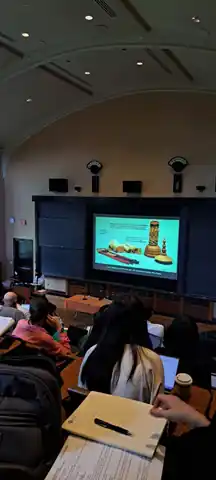
Princeton: the history and importance of an academic setting
Founded in 1746 as the College of New Jersey, Princeton is the fourth-oldest institution of higher education in the United States. After early periods in Elizabeth and Newark, the college moved to Princeton in 1756 with the construction of Nassau Hall. The building was connected with the Battle of Princeton in 1777 and briefly served as the meeting place of the Congress of the Confederation in 1783. The institution formally became Princeton University in 1896, and the Graduate School was organized around the turn of the twentieth century. That historical depth remains visible throughout a campus whose architecture has become part of the university’s identity.
Princeton also occupies a major position in Buddhist and East Asian studies. The conference drew on an environment in which the Department of Religion, the Program in East Asian Studies, the Tang Center for East Asian Art, and the Buddhist Studies Workshop allow texts, objects, practices, and images to be studied together. This institutional configuration closely matched my own approach to Buddhist art: not as an autonomous production, but as material culture bound to patrons, ritual uses, and networks of circulation.
Ritual and materiality
The papers focused on the concrete materiality of religion: manuscripts and printed liturgies, paintings, sculptures, talismans, relics, ritual implements, ritual technologies, and bodily engagement. Papers were circulated in advance so that the sessions could prioritize discussion. The result was demanding and productive: every object had to be placed within a chain of actions, gestures, movements, recitations, offerings, and forms of manipulation.
On the official list of graduate participants, my work appeared under the title The Evolution of Buddhist Art at the Korean Court in Connection with its Donors (14th to 16th Centuries). That formulation placed my research directly within the conference’s central concerns: understanding Buddhist images through the people who commissioned them, the contexts that made them necessary, and the practices that gave them religious and political efficacy.
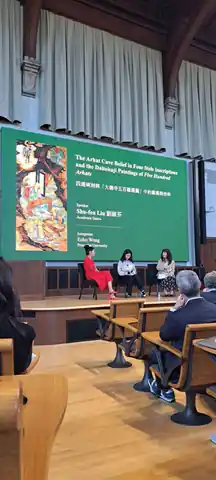
Shu-fen Liu and the keynote on arhats
The keynote was delivered by Shu-fen Liu of the Institute of History and Philology, Academia Sinica, a specialist in the social and religious history of medieval China. Her lecture, The Arhat Cave Belief in Four Stele Inscriptions and the Daitokuji Paintings of Five Hundred Arhats, connected stele inscriptions, beliefs concerning arhat caves, and the celebrated Daitokuji set of Five Hundred Arhats painted in Ningbo between 1178 and 1188. The argument offered a particularly illuminating demonstration of how a belief can materialize simultaneously through sacred landscape, inscription, image, and devotional practice.
Organizers and participants
The conference was co-organized by Stephen F. Teiser and Shih-shan Susan Huang. Teiser, then a professor of religion at Princeton and now D. T. Suzuki Professor in Buddhist Studies and Professor of Religion Emeritus, has devoted much of his scholarship to Buddhist scripture, manuscripts, ritual, and Chinese cave shrines. Susan Huang, T. T. and W. F. Chao Professor at Rice University, studies the visual and material cultures of Buddhism and Daoism in China and East Asia, especially painting, print, and the circulation of images. Together they gave the program a strong balance between religious history, texts, images, and objects.
The two discussants broadened that framework further. Laurel Kendall, an anthropologist and curator at the American Museum of Natural History, is known for research on popular religion, shamanism, and the materiality of sacred objects in Korea, Vietnam, and Southeast Asia. Justin McDaniel, professor at the University of Pennsylvania, works on Southeast Asian religions, manuscripts, Buddhist art and architecture, and lived religious practice.
Several participants were especially close to my own fields of research. Youn-mi Kim works on Korean Buddhist art and ritual; Seunghye Lee, a curator at Leeum Museum of Art, on Chinese and Korean Buddhist art and architecture; Sujung Kim on Japanese and Korean Buddhism through textual and material sources; and Maya Stiller on Korean art, visual culture, and sacred landscapes. Encounters with scholars such as these made the conference immediately relevant to my research on Koryŏ and early Chosŏn.
Graduate researchers at Princeton also played an important organizational role. Kentaro Ide, Sinae Kim, and Junbin Tan contributed to the preparation and scholarly coordination of the meeting. Their presence reinforced one of the most valuable aspects of the conference: invited doctoral students were not treated as passive listeners, but incorporated into a structured community of discussion centered on work in progress.
A week of training and exchange
What remains most strongly with me from that week is the opportunity to listen to specialists working on very different regions, periods, and corpora and then compare their methods. For an art historian, hearing an anthropologist describe the efficacy of a ritual object, a historian read an inscription, or a scholar of religion reconstruct a liturgical sequence changes the way one looks at works of art. Materiality ceases to be a mere property of an object and becomes a condition of its action.
Being selected as one of twenty doctoral students from nearly ninety applicants was therefore less an abstract distinction than a concrete opportunity to enter an international network of scholars working on religion and material culture in Asia. For my own research, the stay strengthened a methodological conviction: the history of Buddhist art becomes richer when written through the relationships linking images, patrons, spaces, gestures, and ritual uses.
Key information
University: Princeton University, Princeton, New Jersey.
Conference: Ritual and Materiality in Buddhism and Asian Religions.
Dates: June 13–15, 2023; approximately one week on campus.
Graduate selection: 20 participants selected from nearly 90 applications.
Scholarly program: 21 scholars, one keynote, and two discussants.
Keynote: Shu-fen Liu, Academia Sinica.
Discussants: Laurel Kendall and Justin McDaniel.
Co-organizers: Stephen F. Teiser and Shih-shan Susan Huang.
Primary sponsor: Glorisun Global Buddhist Network.
Venues: McCosh Hall 50 and Frist Campus Center 302.