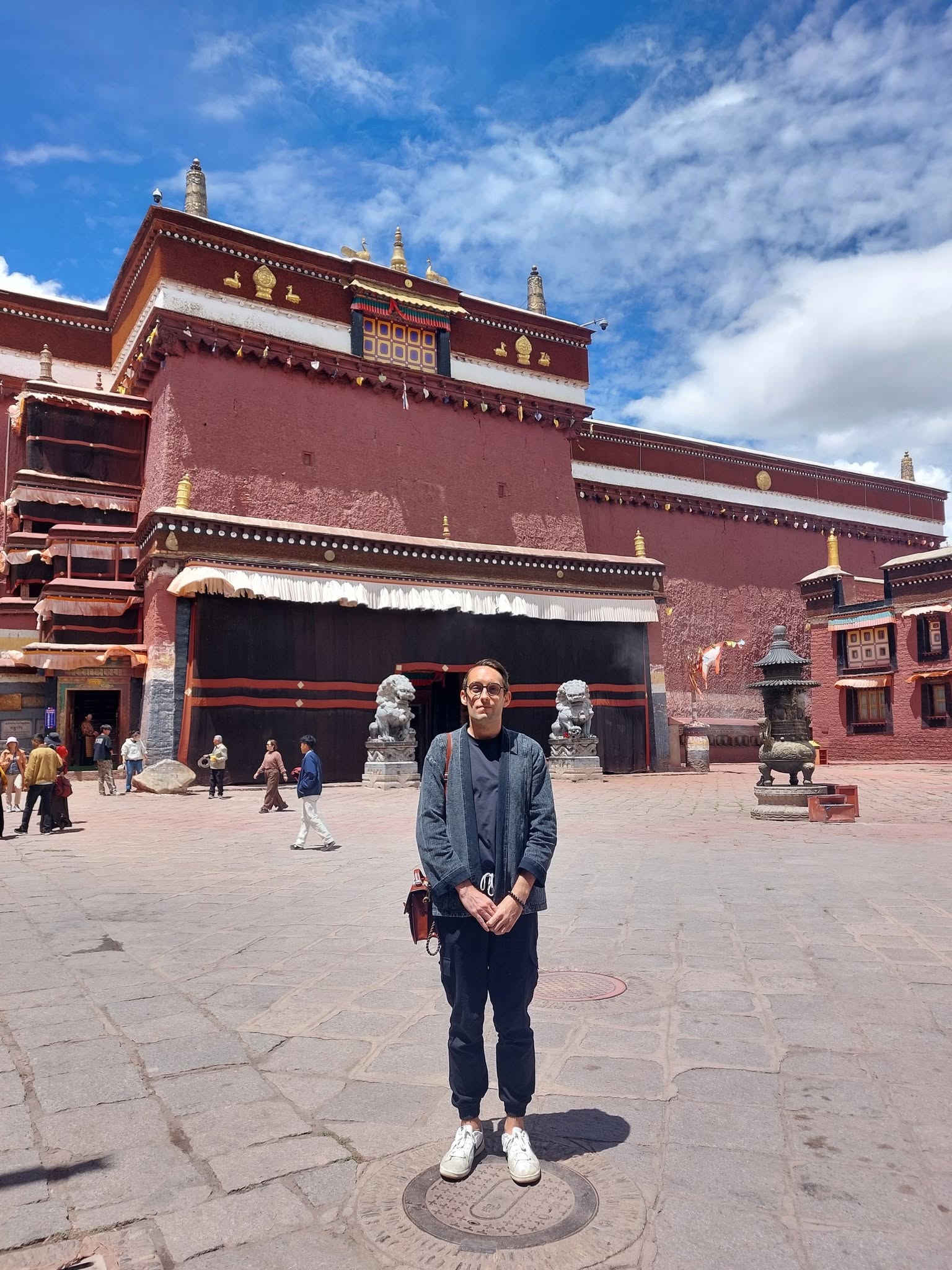
I came to Sakya because its name appears constantly whenever I work on thirteenth-century Tibetan Buddhism, Mongol religious politics, and the movement of ritual forms across Asia. In books, Sakya is an institution. On site, my first impression was far more physical: a massive complex of dark red, white and blue-grey walls rising in the high-altitude landscape, almost military in silhouette.
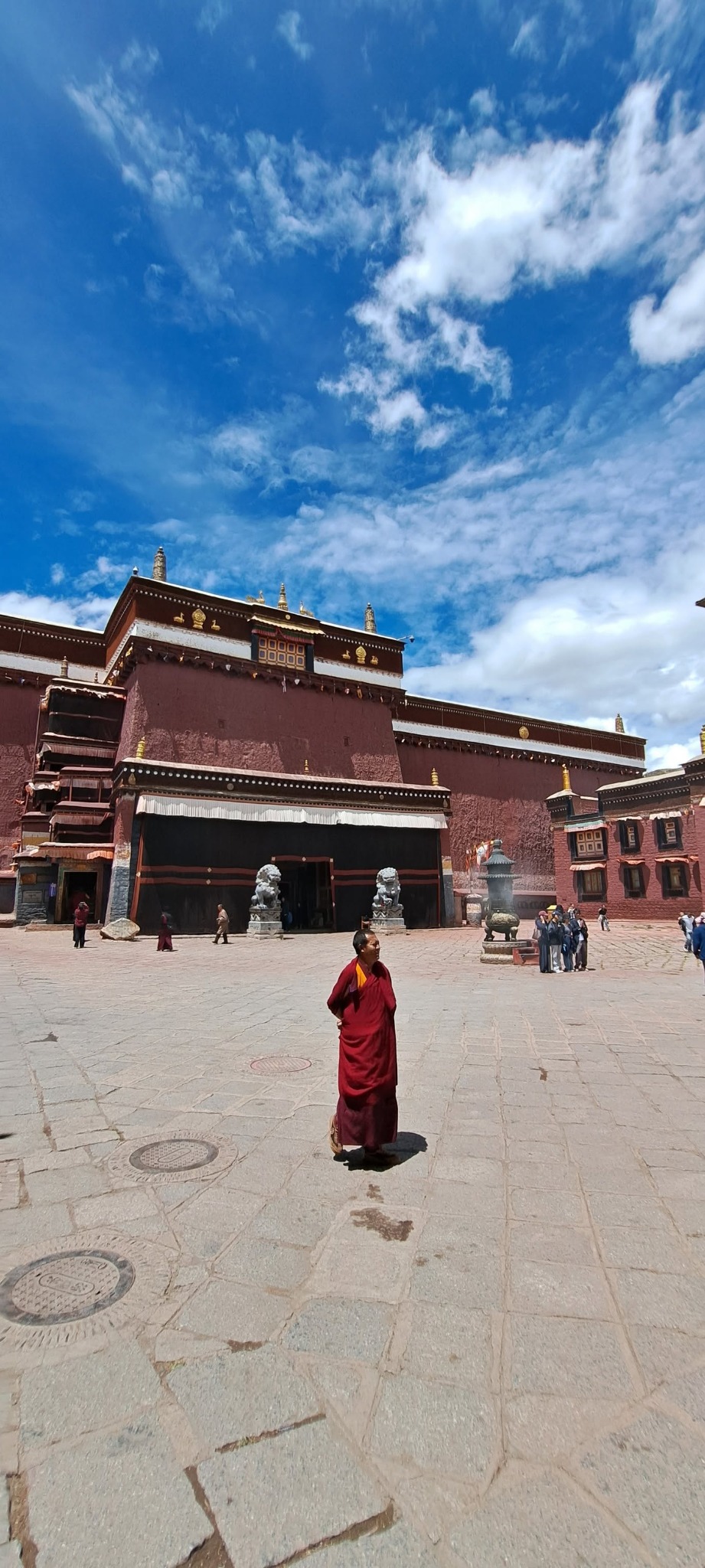
The monastery stands in Tsang, west of Shigatse. Sakya tradition dates its foundation to 1073, when Khön Könchok Gyalpo established the first centre of what became the Sakya school. Entering the courtyard, I understood how misleading photographs can be: they record the colours but not the weight of the architecture. Thick walls, relatively blind façades and compact volumes give the complex the presence of a fortress.
This architecture interested me because it makes political history visible. In the thirteenth and fourteenth centuries Sakya was far more than a monastery. Sakya Paṇḍita’s relationship with the Mongols, followed by that of his nephew ’Phags-pa with Qubilai, placed Sakya hierarchs at the centre of the Yuan imperial system. It is too simple to describe this as “Tibet ruled by Sakya monks”: authority was distributed among Mongol rulers, religious hierarchs and civil administrators. Walking through Sakya nevertheless gives a concrete sense of the institutional scale the monastery had acquired.
For me, Sakya was especially important because my work on Koryŏ led directly back to this world. I nevertheless had to resist an easy shortcut: not everything that reached the Korean peninsula under the Yuan came directly from Sakya. What matters here is the political and religious matrix created by Tibetan hierarchs — especially those of the Sakya tradition — and Mongol imperial power, a matrix into which Koryŏ was increasingly drawn from the second half of the thirteenth century. The Koryŏsa records some very concrete consequences. In 1294, Dge bshes Se-pa (吃折思八), a native of Chindo Island who had been captured during the suppression of the Sambyŏlch’o in 1271, returned to Kaesŏng after being ordained and trained in the Tibetan tradition within the Yuan world; his return also brought Tibetan Buddhist texts and ritual implements to the court. In 1314, the sources record another Tibetan monk presenting the Koryŏ court with a very large corpus, described as more than eighteen thousand Tibetan Buddhist texts. Visiting Sakya therefore did not mean searching for a single point of origin. It meant standing in one of the major institutional centres of the network that made such circulations possible. The iconographic, ritual and material traces I study in Korea acquired here a much wider Eurasian depth.
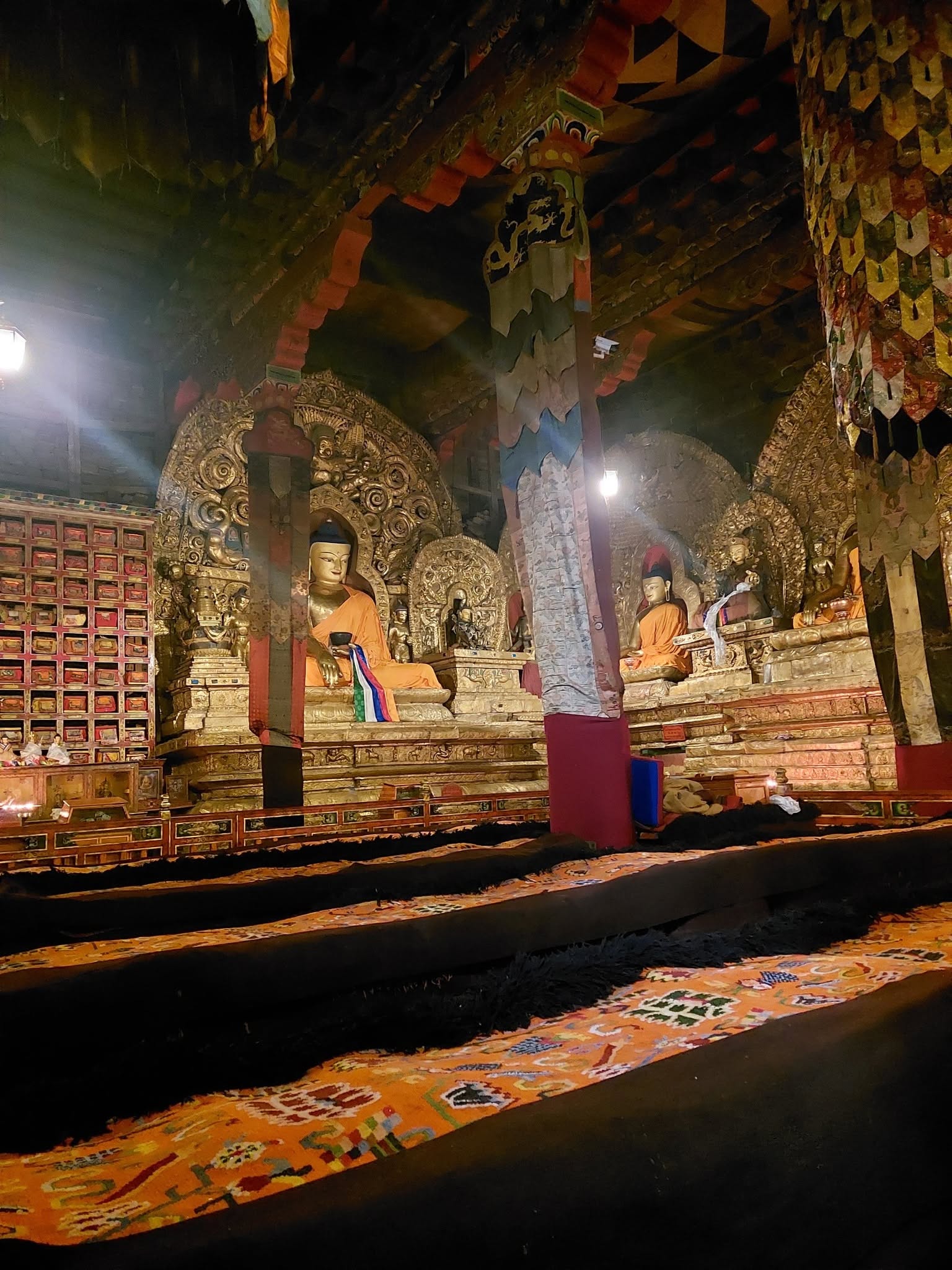
The transition from the courtyard to the interior was one of the strongest moments of my visit. Outside everything feels mineral and monumental. Inside, light becomes scarce, colours deepen and statues gradually emerge from darkness. I spent time looking not only at the images themselves but at the way they are installed among textiles, offerings, lamps and smaller figures. In a museum we often isolate an artwork. Here the image is never alone.
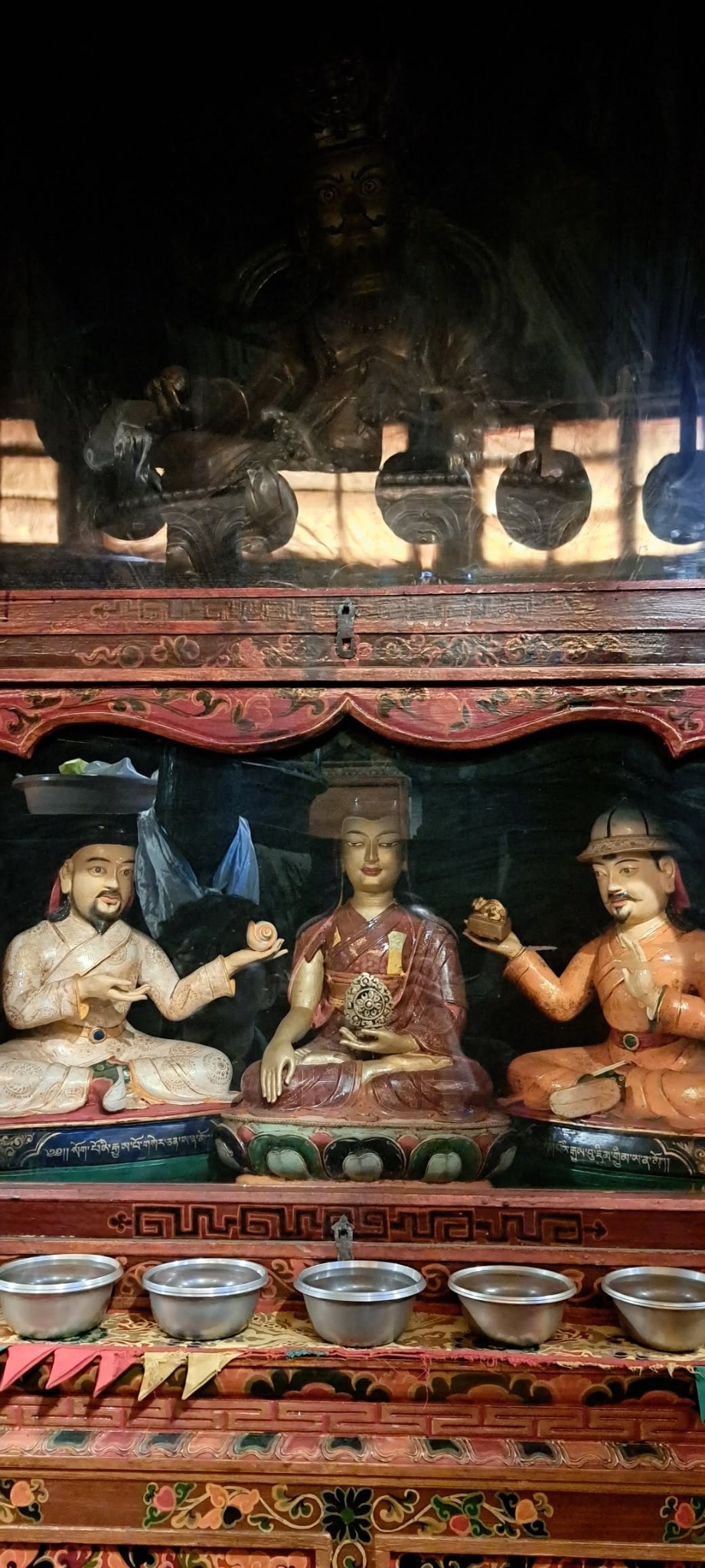
This difference matters for art history. Gilded bronzes, clay sculptures, paintings and altars can be studied through style, iconography and dating, but Sakya constantly brought me back to function. Traces of devotion, textiles, offerings and successive alterations show that these objects continue to be activated through religious practice. What I photographed was therefore not simply heritage, but a living religious environment.
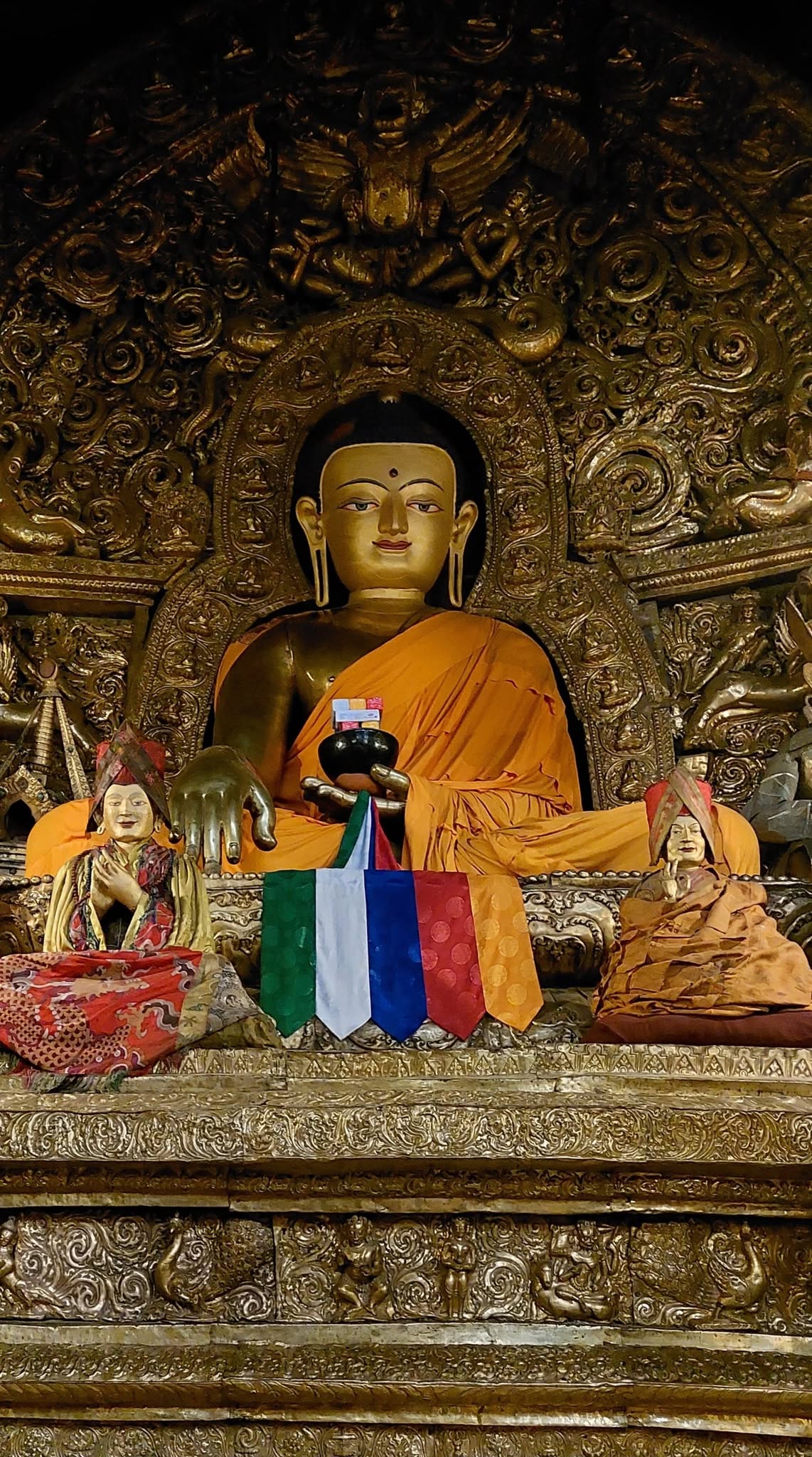
I spent a long time in front of this group. Seeing ’Phags-pa positioned between Činggis Qan and Qubilai Qan gives visual form to a relationship between religious master and ruler that political diagrams tend to flatten. This is precisely what matters for my work on Koryŏ: the peninsula did not simply receive an undifferentiated “Mongol Buddhism”, but religious forms shaped through the interaction of Tibetan hierarchs and imperial power. The group therefore gave me a visual bridge between Sakya and the transformations I study in late Koryŏ court Buddhism.
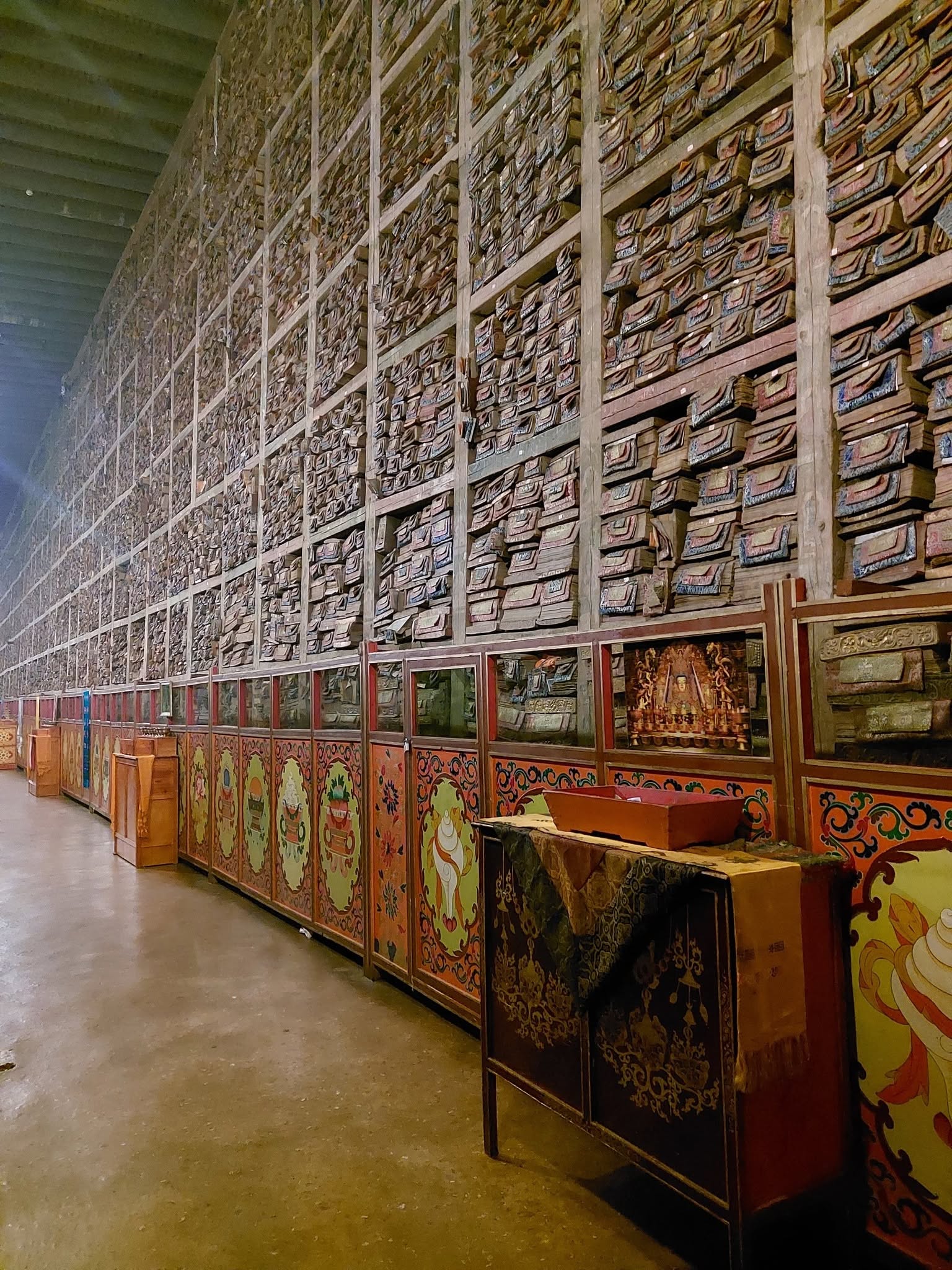
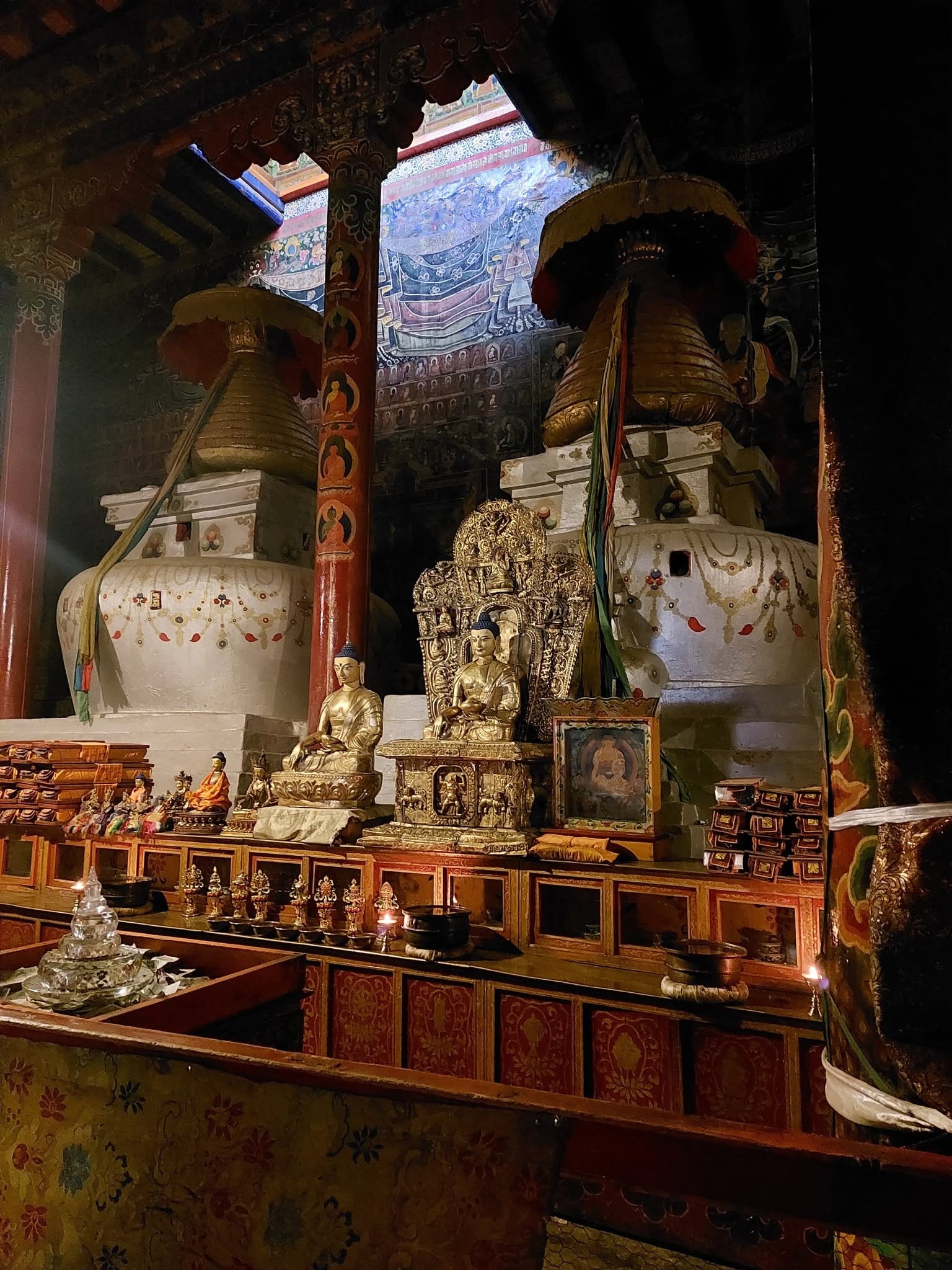
The library was probably the space that impressed me most intellectually. High wooden shelves are packed with wrapped volumes, stacked so high that one has to tilt one’s head back to take in the whole wall. Sakya preserves one of Tibet’s major textual collections, including canonical corpora and many ancient manuscripts. Travel writing and popular accounts sometimes call it a “second Dunhuang”. The comparison is dramatic and should be used cautiously, but it conveys something of the scale of the collection.
Standing in front of those shelves, I thought above all about the material chain of transmission. A Buddhist text is not an abstraction: it has to be copied, translated, corrected, printed, transported, preserved and read. For understanding religious circulation between Tibet, China and Koryŏ, these material objects matter as much as the doctrines they transmit.
Another aspect of Sakya that interested me was the coexistence of institutional Buddhism and local traditions. A small rooftop shrine is sometimes described locally as the “Chapel of the Witches”. Tradition says it was used to subdue harmful female spirits or sorceresses. I prefer to preserve this as a tradition rather than turn it into a historical fact. Even so, it is revealing of the way Tibetan sacred landscapes absorb narratives of protection, subjugation and the control of local forces.
I left Sakya thinking less of an isolated monument than of a node: between study and devotion, architecture and political power, material culture and textual transmission, Tibetan history and wider Eurasian networks. That is why the visit mattered to me. It gave scale, light and material presence to historical processes that can become too abstract when encountered only through texts.
Reference points
Foundation: 1073, traditionally attributed to Khön Könchok Gyalpo.
Location: Sakya, Tsang, Shigatse region.
Coordinates: approx. 28.905° N, 88.018° E.
Tradition: Sakya school of Tibetan Buddhism.