India — The birth and development of the stupa
1. What is a stupa?
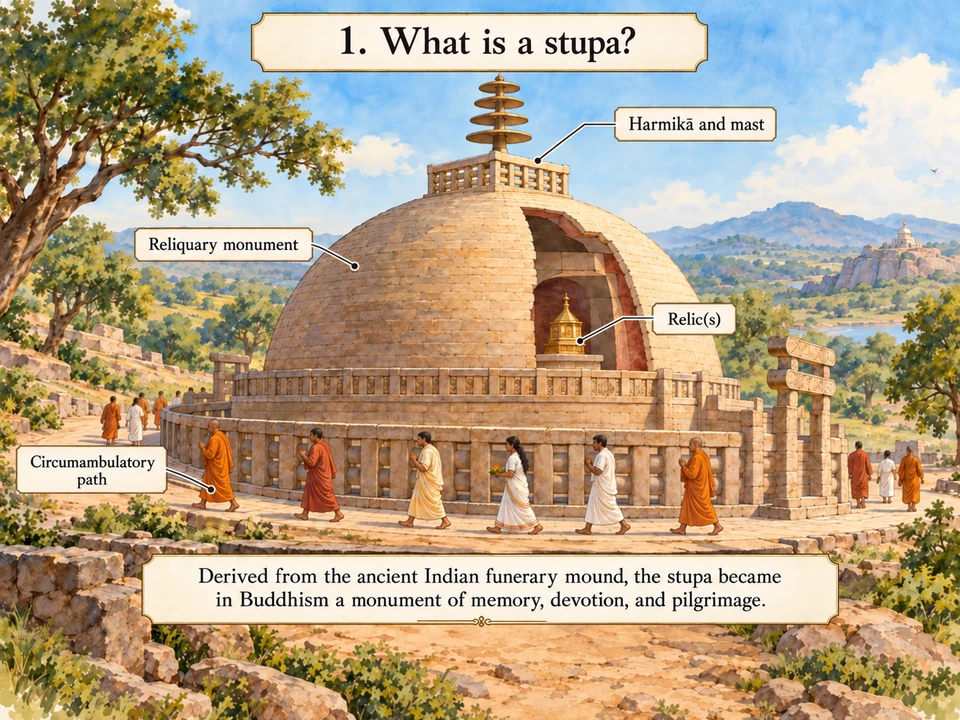
The word stūpa originally referred to a heap, mound, or funerary monument. In ancient India such a form could cover the cremated remains of the dead. Buddhism adopted this tradition but gave it a distinctive religious value: the stupa became a container for the relics of a being whose spiritual attainment justified collective veneration. Early texts connect this dignity especially with the Buddha, arhats, and the universal monarch or cakravartin. The architectural form gradually stabilised. A base supports a hemispherical mass, the aṇḍa, above which rise a harmikā and a mast carrying one or more parasols. A railing may enclose the monument and organise a circumambulatory path. The stupa is therefore simultaneously tomb, reliquary, memorial, and ritual centre. It should be distinguished from the caitya, which can denote a commemorative place or monument not necessarily containing bodily relics. Yet the distinction became increasingly porous as corporeal relics grew scarce. Texts, dhāraṇī, and doctrinal formulas could be inserted as “relics of the Dharma (法) body.” The stupa no longer preserved only the Buddha’s physical remains; it could preserve the teaching itself. This extension was decisive because it allowed stupas to multiply without depending on a finite stock of śarīra.
2. Stupas in the Buddha’s lifetime
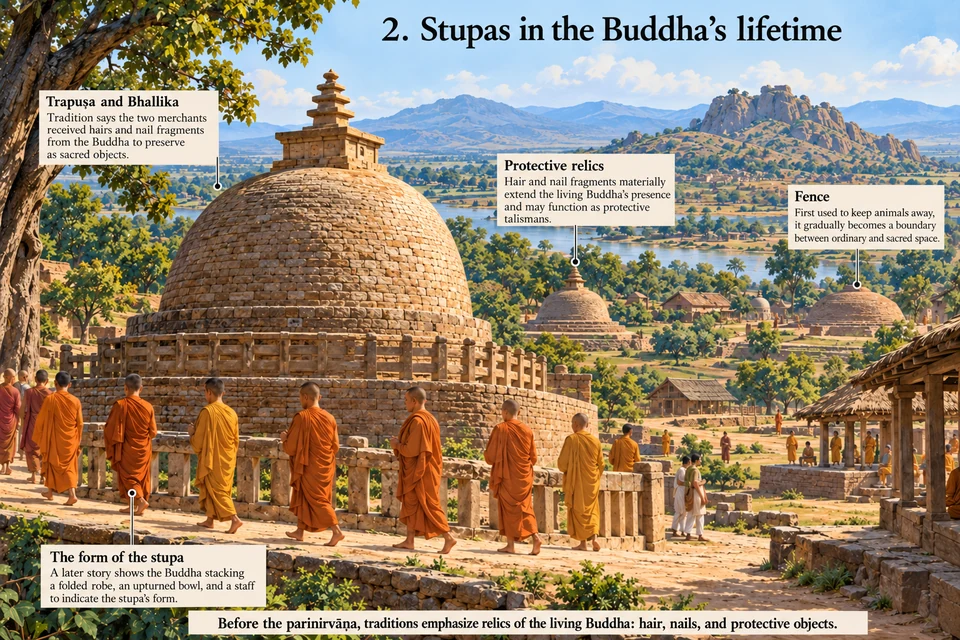
Buddhist tradition traces some stupas back to the Buddha’s own lifetime. After his awakening, the merchants Trapuṣa and Bhallika are said to have received hairs and nail fragments to preserve as protective objects, later enshrining them in a monument. Later narratives even claim that the Buddha demonstrated the form of a stupa by stacking a folded robe, an upturned bowl, and a staff. This scene is probably a later doctrinal reconstruction, but it reveals a desire to anchor the canonical monument in the Buddha’s own authority. Other traditions mention portable relics, especially hair, given to travellers or warriors as protective talismans. Before the Buddha’s death, the stupa thus appears above all as an extension of a living sacred presence. Fences erected to keep animals away from early monuments gradually acquired ritual significance by separating ordinary from sacred space. After the parinirvāṇa, the Buddha’s personal objects—bowl, robe, staff—were also invested with memorial power. A chronological distinction emerges: traditions about the living Buddha stress hair, nails, and protection, while posthumous traditions institutionalise bodily relics and associated objects. The stupa became one of the primary means of making a person permanently present after physical absence.
3. Parinirvāṇa and the division of the relics
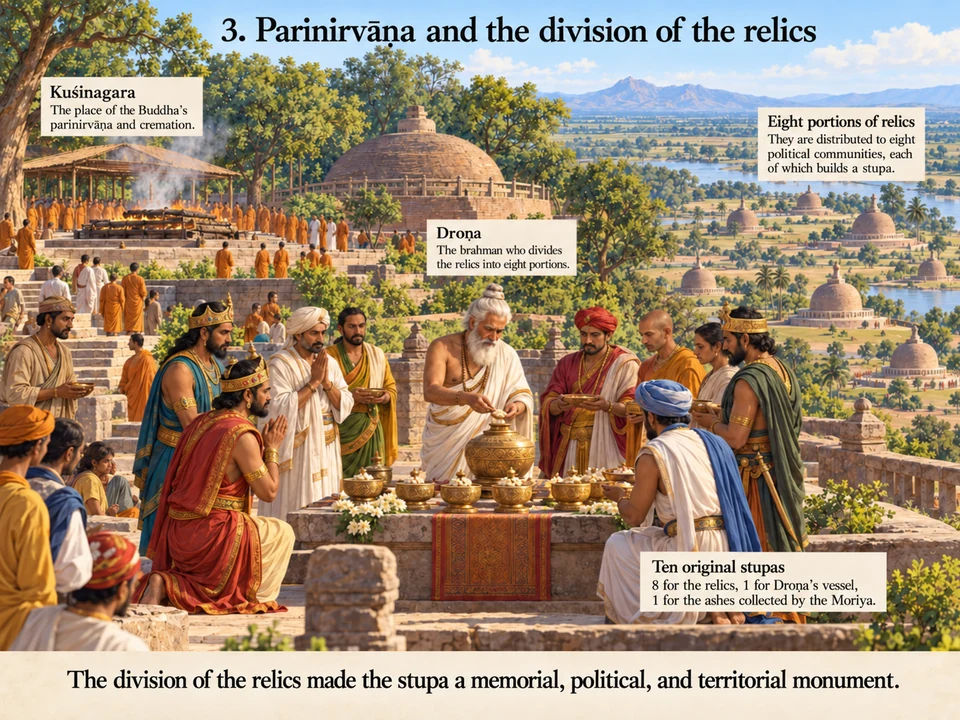
The Buddha’s parinirvāṇa at Kuśinagara marks the foundational event of the great relic cult. After cremation, several kingdoms claimed a share of the remains. The brahman Droṇa is said to have divided them into eight portions distributed among eight political communities, each of which built a stupa. Droṇa retained the vessel used for the division and dedicated a ninth monument to it; the Moriya, arriving after the distribution, collected the ashes of the pyre and raised a tenth. Tradition thus speaks of ten original stupas. The narrative reveals above all that relics were political and territorial assets from the beginning. Possessing a fragment of the Buddha allowed a kingdom to anchor his presence locally and to attract devotion. At the same time, commemorative monuments developed around major events of his life. Four sites became fundamental: Lumbinī for the birth, Bodhgayā for awakening, Sārnāth for the first sermon, and Kuśinagara for the parinirvāṇa. Other locations associated with miracles or memorable episodes were added. Two logics therefore coexisted: physical presence through relics and localised memory through event sites. When a stupa stood at a sacred place, these forms of sanctity could merge. Buddhism thereby developed an early sacred geography in which monument, relic, story, and pilgrimage reinforced one another.
4. Who built stupas, and where?
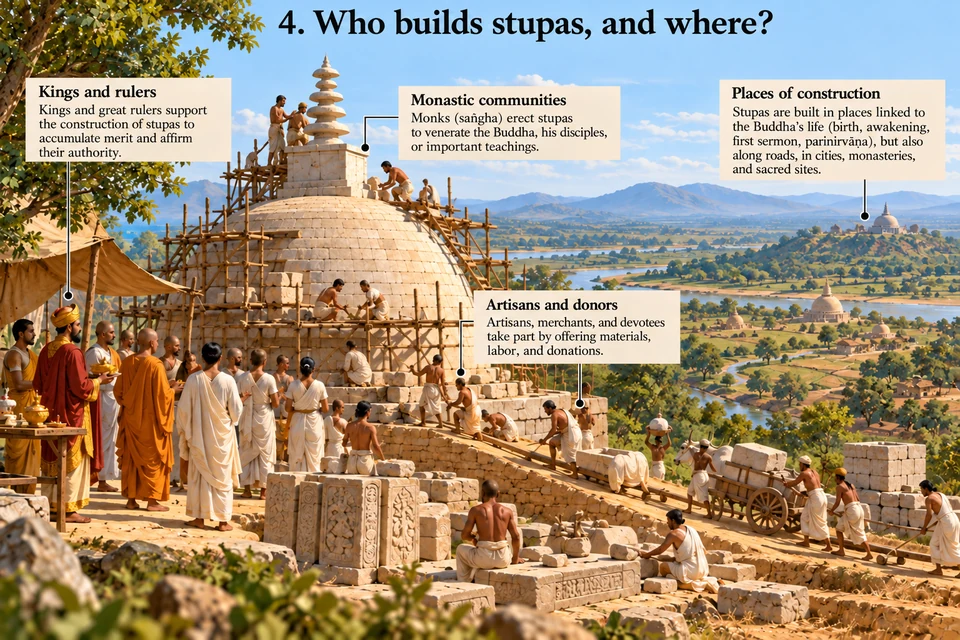
The earliest stupas were not directly part of monastic administration. Narratives about the parinirvāṇa assign laypeople responsibility for relics and monument building, while monks are expected to continue practice and teaching. This helps explain why stupas were often placed in highly visible public locations. The Buddha is said to have recommended crossroads, where many people could see the monument, pay homage, and generate merit. The stupa initially belonged to a public devotional sphere, whereas the monastery was the space of residence and discipline for the saṃgha (僧伽). Donors, rulers, merchants, and urban communities therefore played a major role in construction and decoration. This encouraged a monumental material Buddhism alongside ascetic life. Before anthropomorphic images of the Buddha became widespread, the stupa was one of the principal visible forms able to stand for his presence. It could be saluted, circumambulated, and adorned with flowers, banners, and lamps. Its position on roads and in settlements made it accessible to a far broader public than monastic institutions alone. Later Buddhist architectural history would largely be the story of bringing these two spheres together: the lay monument of devotion and the monastery organised around the religious community.
5. Sāñcī and Bhārhut: the stupa becomes narrative
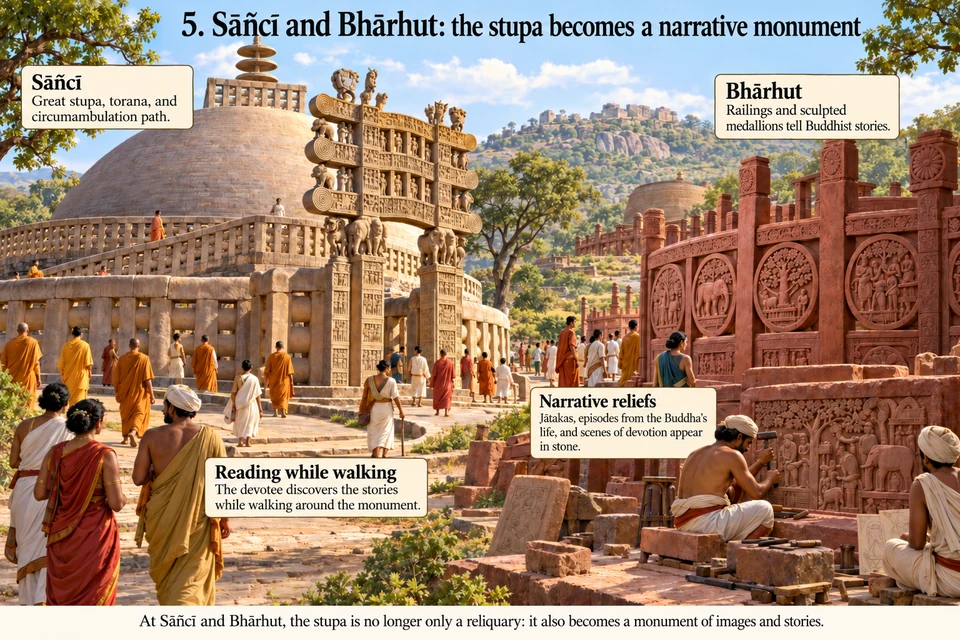
The great stupas of Sāñcī and Bhārhut show how a reliquary could become an architecture of narrative. The relics sealed inside were invisible; to make the Buddha perceptible, the surfaces around the monument were increasingly covered with images relating his life and previous existences. Jātaka stories gave the monument narrative depth, presenting the stupa not merely as a sacred tomb but as the culmination of a spiritual path extending across innumerable lives. The Great Stupa at Sāñcī, whose core dates to Aśoka (阿育王)’s reign in the third century BCE, was enlarged and decorated over time. Its four torana gateways, placed at the cardinal points, carry rich sculptural programs. The railing defines sacred space and organises ritual circulation. At Bhārhut, surviving fragments of the fence and gateways show a comparable logic: inscriptions, narratives, protective figures, and Buddhist symbols turn the approach to the monument into a pedagogical and devotional experience. These sites demonstrate that Buddhist architecture is never only built form. It combines movement, story, image, and memory. Around the stupa, devotees learn while walking. Sculpture accompanies circumambulation and transforms architecture into a narrative sequence, anticipating the iconographic programs later developed in caves, pagodas, and halls across Asia.
6. Circumambulation and cosmology
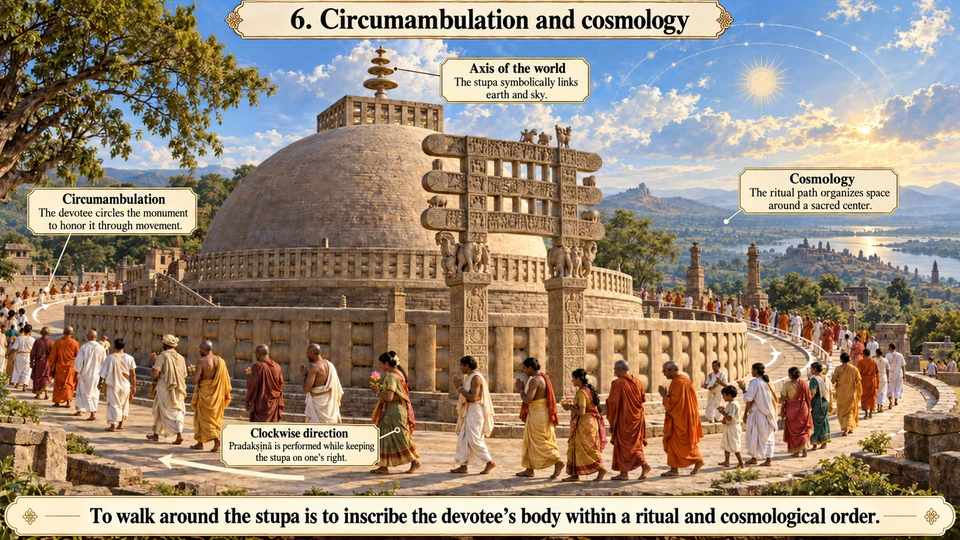
Circumambulation turns the stupa into the centre of a ritual field. Devotees move around the monument clockwise, keeping it on their right. This practice, pradakṣiṇā, predates Buddhism and expresses respect for a sacred person or object. Early texts already describe disciples circling the living Buddha several times; after his parinirvāṇa the same gesture was transferred to his reliquary. Bodily movement thus gives devotion a spatial form. At the same time, the stupa acquired cosmological interpretations. The main mass could evoke the world, the harmikā Mount Sumeru, and the mast with its parasols an axis linking earth and heaven. The monument became a condensed representation of the Buddhist universe. This helps explain the increasing importance of verticality and superposed crowning elements. In rock-cut caitya halls, the plan is specifically designed to permit walking around the stupa at the end of the apse. Later, when statues became major cult objects, circumambulation was also transferred to the image and the hall. The practice therefore provides a continuous thread between the Indian stupa and many East Asian buildings: the sacred centre changes form, but the devotee’s body continues to establish its centrality through movement.
7. From the Buddha’s stupa to the master’s stupa
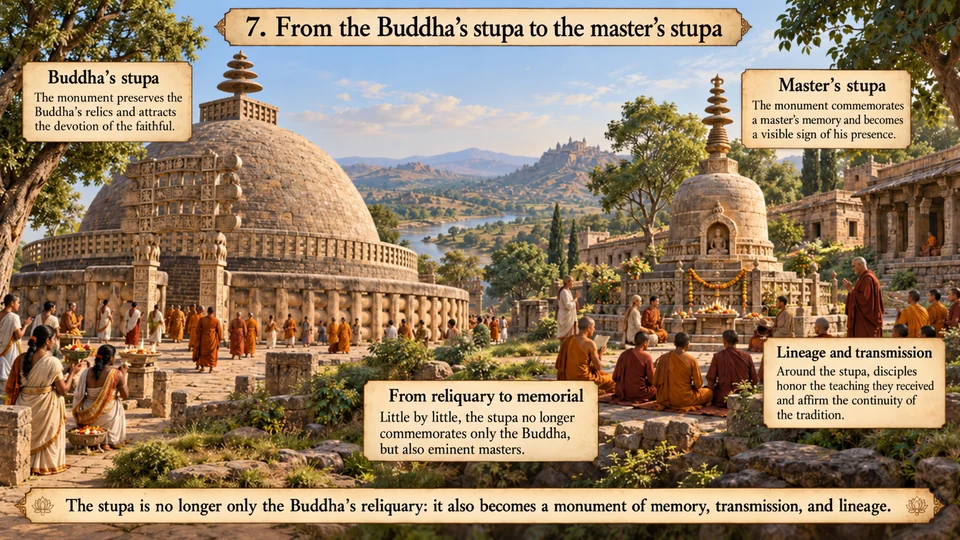
The reliquary principle was not limited to the Buddha. Great disciples and later eminent teachers could also receive funerary monuments. This extension is particularly important for East Asia. In China and Korea, relics of distinguished monks were placed in individual stupas. In Korea these monuments are traditionally called pudo (浮屠), an old term with a complex semantic history, or more explicitly sŭngt’ap (僧塔), “monk stupa.” Their expansion is closely linked to the development of Sŏn (禪) in late Silla (新羅). In a tradition where transmission from master to disciple is central, the master’s body after death becomes the material support of a spiritual lineage. Early monumental examples often use an octagonal, highly architectural form, as though a small pavilion had been transformed into a stone reliquary. Under Koryŏ (高麗), types diversified and simpler shapes resembling an inverted bowl or stone bell became common. The transition from the Buddha’s stupa to the teacher’s stupa shows how an institution born from foundational relics could be reused to construct the memory of local communities. The monument no longer commemorated only the origin of Buddhism; it materialised a genealogy, a transmitted teaching, and the authority of a particular master.