1277
At the side of the ailing king
Yŏm Sŭngik accompanies Ch’ungnyŏl to the monastery of Ch’ŏnhyo 天孝寺 and takes part in the ruler’s care. The episode strengthens his proximity to the king.
Koryŏsa 高麗史, k. 123, 8a–11a.
Power, devotion, and artistic production at the court of King Ch’ungnyŏl 忠烈王.
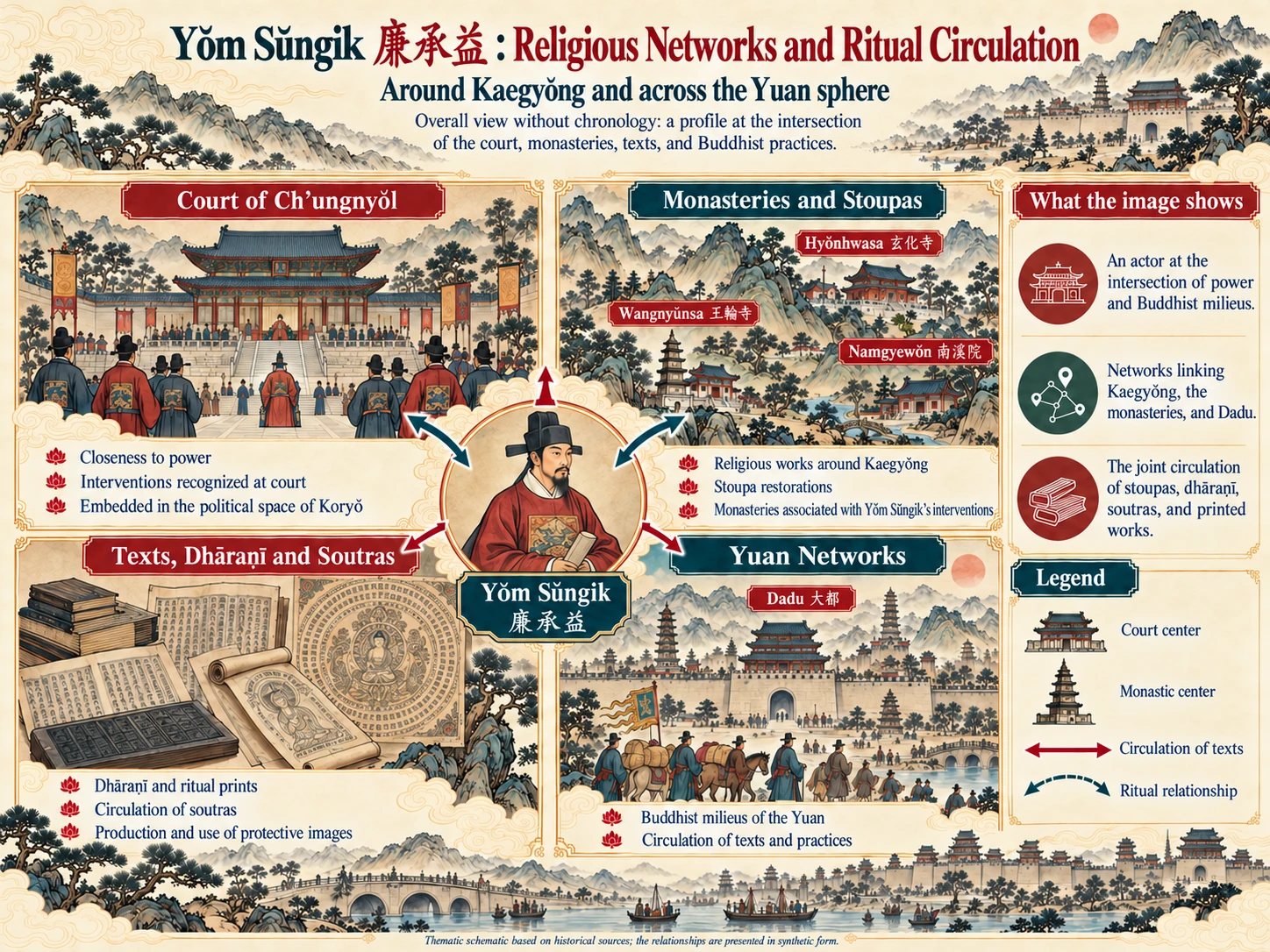
A high official, interpreter of Mongolian, close associate of the ruler, and devout Buddhist, Yŏm Sŭngik (?–1302) provides an exceptional vantage point on the links between court, monasteries, stupa restoration, sūtra copying, and image commissioning in Koryŏ.

Yŏm Sŭngik’s biography in the Koryŏsa 高麗史 places him among the ruler’s close associates. His career reached a decisive turning point in 1277, when he accompanied King Ch’ungnyŏl to the monastery of Ch’ŏnhyo 天孝寺 during the king’s illness and took part in his care. Yet Yŏm Sŭngik’s role extended beyond the court: he also became an intermediary between royal power and Buddhist institutions.
Yŏm Sŭngik spoke Mongolian and served as an interpreter for envoys arriving from Dadu. He thus belonged to the group of high officials who mediated between the kingdom of Koryŏ and the Yuan court. At the same time, his Buddhist devotion took material form through donations, ritual practices, and artistic commissions.
This dual position explains his importance: Yŏm Sŭngik cannot be reduced either to a private commissioner or to his administrative role alone. He connected royal authority, administrative resources, monasteries, artisans, copyists, and votive practices.
Principal source: Koryŏsa 高麗史, k. 123, 8a–11a, biography of Yŏm Sŭngik in the section on “favorites”; Bryan Sauvadet’s dissertation, chap. 1, § 1.1.2.2.1.
Yŏm Sŭngik accompanies Ch’ungnyŏl to the monastery of Ch’ŏnhyo 天孝寺 and takes part in the ruler’s care. The episode strengthens his proximity to the king.
Koryŏsa 高麗史, k. 123, 8a–11a.
Royal favor brings promotion and admission into circles where affairs of the kingdom are deliberated.
Koryŏsa 高麗史, k. 123, 8a–11a.
On the order of Ch’ungnyŏl and a royal princess, Yŏm Sŭngik has a new pavilion erected at the monastery. Here he acts as the executor of a royal commission.
Koryŏsa 高麗史, k. 29, 9a–b.
He makes one of his dependencies available for the installation of the royal scriptorium devoted to copying the Great Canon in gold characters: 金字大藏寫經所, Kŭmja taejang sagyŏngso.
Ch’ungnyŏl charges Yŏm Sŭngik and Kong Yu 孔愉 with supervising restorations at Hyŏnhwa, Wangnyun, Namgyewŏn, and a dependency of Kaeguk Monastery. Around the same time, Yŏm Sŭngik commissions the Lotus Sūtra associated with the Namgyewŏn stupa.
Koryŏsa 高麗史, k. 29, 45a.
Yŏm Sŭngik commissions a painting of Amitābha to formulate vows for the royal family, his relatives, and rebirth in the Pure Land.
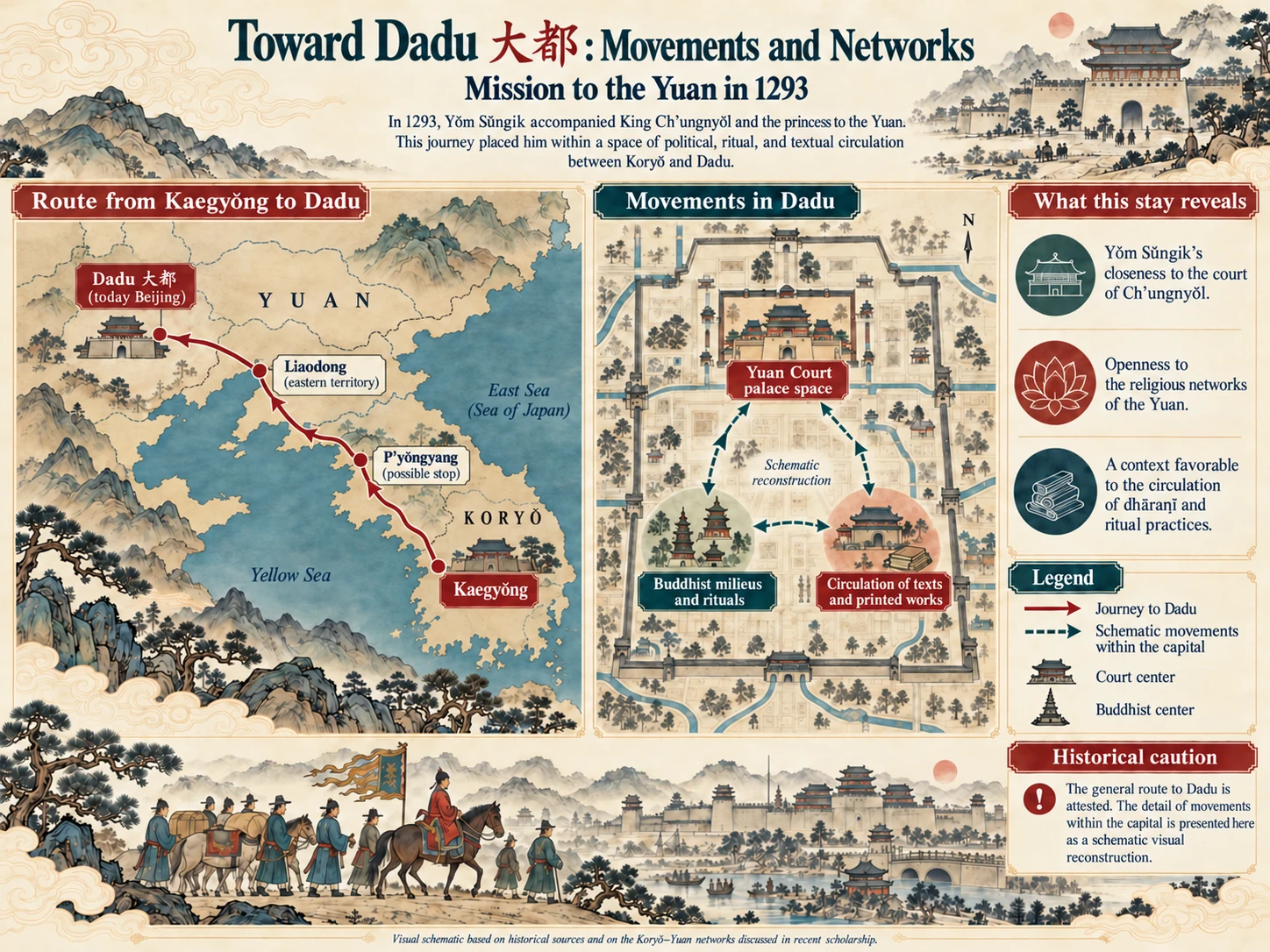
Yŏm Sŭngik accompanies the king and queen to Dadu, revealing his position within relations between Koryŏ and the Yuan.
See also Yŏm Sŭngik’s biography in the Koryŏsa 高麗史, k. 123, 8a–11a.
A woodblock matrix and its impressions attest to another form of patronage: a reproducible textual image intended for ritual efficacy.
Yŏm Sŭngik again accompanies the royal couple.
See Koryŏsa 高麗史, k. 123, 8a–11a.
Illness leads Yŏm Sŭngik to withdraw from political affairs without ending his religious commitments.
See Yŏm Sŭngik’s biography in the Koryŏsa 高麗史, k. 123, 8a–11a.
During the illness of a royal princess, Yŏm Sŭngik is recalled to court and performs extreme devotional practices, showing the persistence of his reputation as a healer.
After refusing new appointments, Yŏm Sŭngik returns his titles, becomes a Buddhist monk, and dies in the same year.
Koryŏsa 高麗史, k. 32, 10a; see also k. 123, 8a–11a.
The sources associate Yŏm Sŭngik with undertakings of different status. Conflating them would make him the commissioner of works that in fact originated with Ch’ungnyŏl.
After the destruction and damage connected with the Mongol wars, Ch’ungnyŏl entrusts Yŏm Sŭngik and Kong Yu with a mission among the Buddhist institutions of the capital. The itinerary documented in the dissertation links four sites.
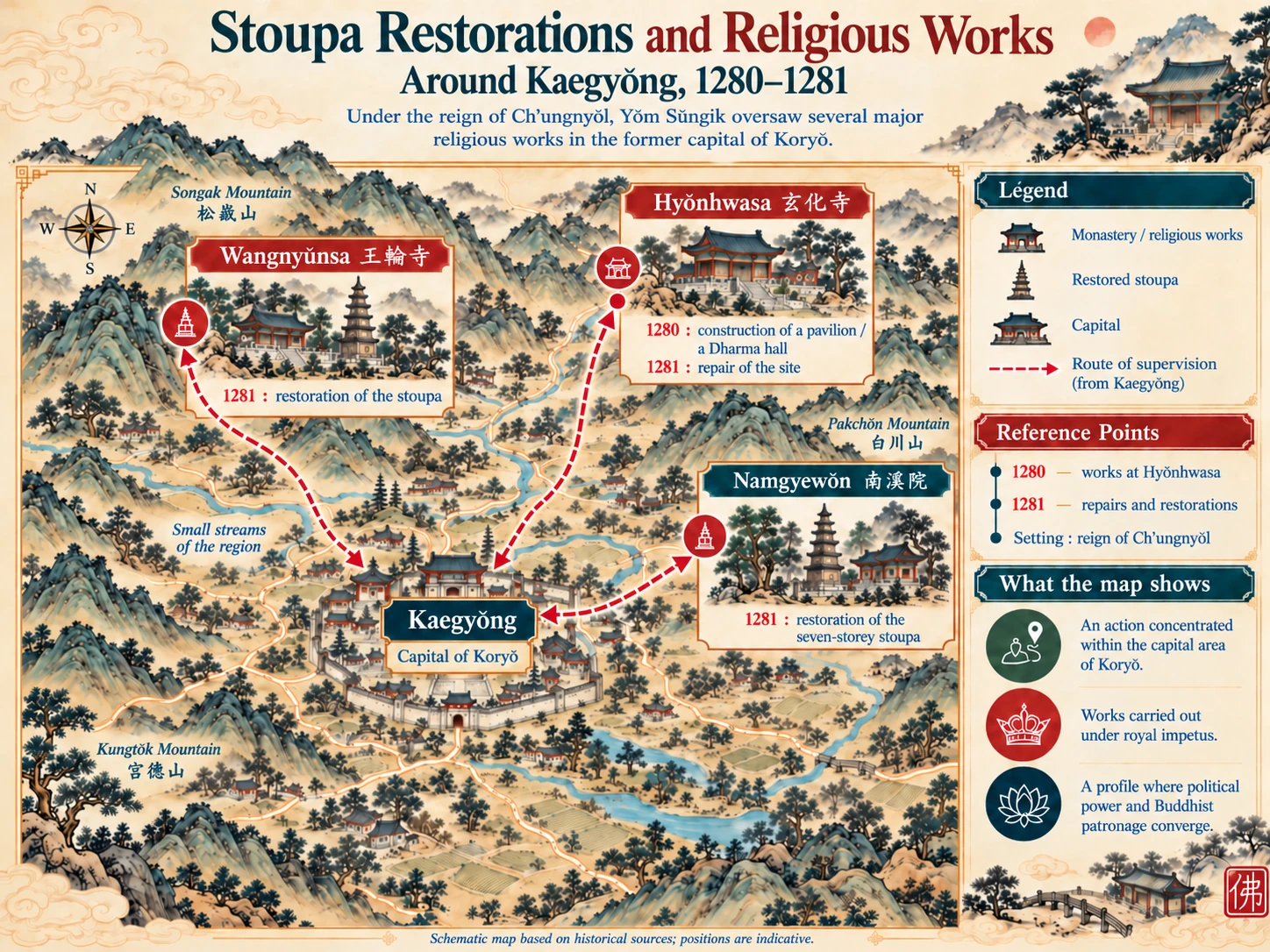
A monastery already linked to Yŏm Sŭngik through the royal architectural commission of 1280.
One of the capital’s major institutions included in the restoration program.
The crucial case: the surviving stupa connects architecture, restoration, and the deposition of a sūtra.
A dependency of the monastery also appears in the mission reported by the sources used in the dissertation.
Textual source: Koryŏsa 高麗史, k. 29, 45a. The page does not artificially reconstruct the appearance of lost monuments: only Namgyewŏn is developed here as a material case study where the monument and associated objects are documented.
The seven-story stone stupa from the Namgyewŏn site near Kaesŏng is where Yŏm Sŭngik’s biography intersects most directly with the materiality of an object. When the monument was dismantled and relocated in the early twentieth century, Buddhist scrolls were discovered inside.
The monument is now preserved at the National Museum of Korea. The discovery of scrolls copied in metallic ink on indigo paper allows the stupa to be read not only as architecture, but also as a space of deposition.
The stupa materializes Buddhist presence in the landscape of Kaegyŏng.
Part of the architecture becomes inaccessible once sealed.
The text is no longer intended for ordinary reading: it becomes a votive object incorporated into the monument.
In the interpretation developed in the dissertation, the sūtra functions as a relic and participates in the consecration of the stupa.

The colophon identifies Yŏm Sŭngik as the commissioner. Its association with the restoration of the Namgyewŏn stupa gives the work a function beyond luxury copying: it was conceived for deposition within a consecration device.

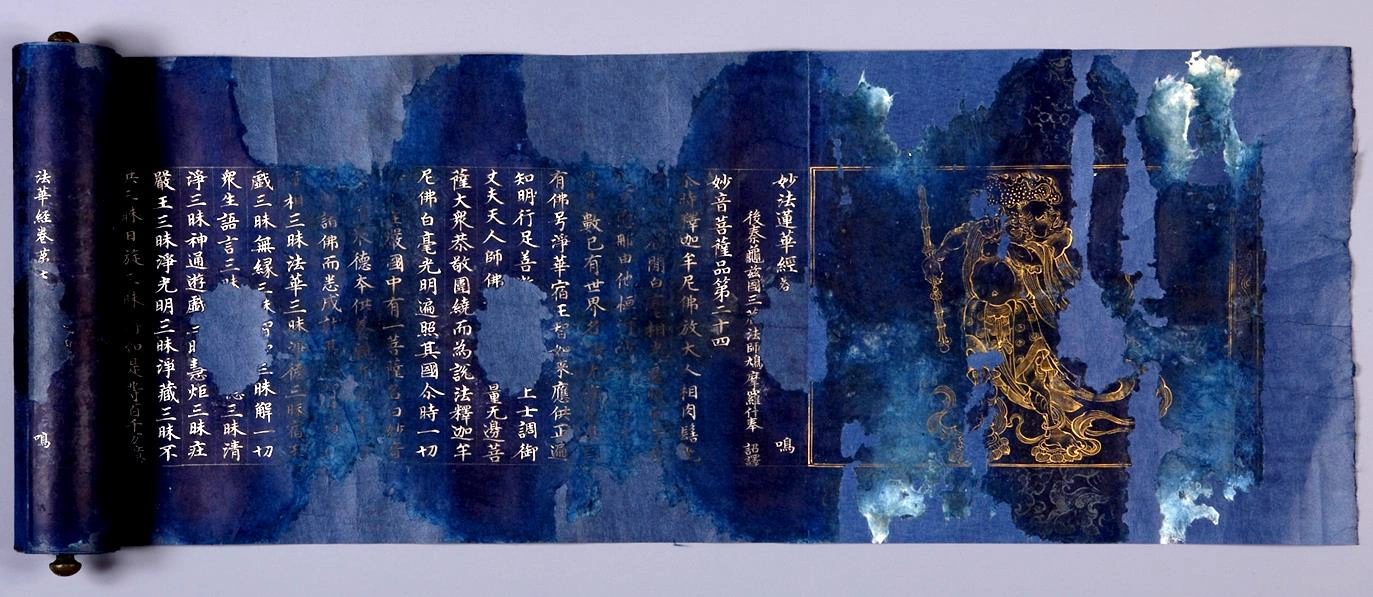
The first of the seven rolls discovered in the stupa 塔 at Namgyewŏn is the best preserved. On indigo-dyed paper, the text is copied in silver, while the cover and frontispiece are executed in gold. The image is remarkable for its iconographic economy: rather than presenting an extended narrative scene, it isolates a single wrathful figure standing on a lotus throne 蓮華座 and holding a large vajra 金剛杵 (kŭmgangjŏ) in the right hand.
The body turns to the left while the head twists in the opposite direction. The pronounced musculature, animated folds of the garment, tension of the arms, and flames surrounding the head give the figure an energetic, protective presence. The composition does not seek to narrate the contents of the sūtra; instead, it concentrates the power of the Dharma 法 into an immediately legible image. Stylistically, it is very close to protective figures in illustrated sūtras 經 produced around 1275–1276, notably the Sūtra of the Mantras of the Miraculous Transformations of the Amoghapāśa and the Sūtra of the Bodhisattva 菩薩 Mañjuśrī 文殊師利.
This simplicity becomes especially meaningful when the manuscript’s destination is considered. The seven rolls were not intended to remain visible: they were deposited inside the stupa 塔 restored in 1283. The image should therefore be understood less as an aid to contemplation than as a condensed and operative ritual presence. Such an object can be understood as a “sūtra as relic”: the sacred text, its protective image, and the monument enclosing them together form a device of consecration. This interpretation resonates with the passage in the Lotus Sūtra 妙法蓮華經 that equates the presence of the text with that of the very body of the Tathāgata 如來.
The manuscript commissioned by Yŏm Sŭngik around 1283 and discovered in the Namgyewŏn stupa is preserved in the National Museum of Korea.
Three years after the restoration of Namgyewŏn, Yŏm Sŭngik commissions a painting of Amitābha. Its inscription prays for the happiness and longevity of the king, the princess, and Yŏm Sŭngik’s relatives, while reaffirming the hope of rebirth in the Pure Land.

The connection with the Lotus Sūtra is not merely chronological: the same four-line gāthā appears in both ensembles. The writing deposited within the stupa and the image made for devotion therefore participate in the same votive horizon.
The Dhāraṇī of the Precious Casket Seal 寶篋印陀羅尼, produced under Yŏm Sŭngik’s supervision, introduces a different material logic: no longer a unique object, but a matrix enabling the multiplication of impressions intended for ritual use.

The object combines text, diagrammatic structure, and ritual power. Woodblock printing transforms the nature of Yŏm Sŭngik’s patronage: a single matrix can generate multiple impressions that then circulate in contexts of consecration.
Rather than isolating each work by medium, their sequence shows how the same concerns—protection, longevity, merit, and salvation—move from manuscript writing to painting and then to the printed image.
Votive copying, deposition in the stupa, and transformation of the text into a reliquary presence.
A devotional painting that reiterates the same votive horizon of rebirth in the Pure Land.
The woodblock matrix enables the multiplication of ritual objects without separating text from image.
Yŏm Sŭngik’s trajectory intersects with several major monasteries of Kaegyŏng, but this page does not duplicate the general map of the capital’s Buddhist networks. It isolates only Yŏm Sŭngik’s own path: Ch’ŏnhyo → Hyŏnhwa → royal scriptorium → stupa mission → Namgyewŏn.
The final phase of Yŏm Sŭngik’s life gives further coherence to his religious patronage. In 1295, ill health leads him to withdraw from political affairs. Two years later, his reputation as a healer brings him back into contact with the royal family. In 1302, after refusing new appointments, he relinquishes his titles and becomes a Buddhist monk shortly before his death.
For the biographical trajectory: Koryŏsa 高麗史, k. 123, 8a–11a; for 1302: k. 32, 10a.
Illness interrupts his active political career, but not his religious practices.
The court continues to call on Yŏm Sŭngik in therapeutic and ritual contexts.
His final renunciation of court titles closes a trajectory in which political office and Buddhist commitment had constantly coexisted.
Yŏm Sŭngik allows us to understand Buddhist art in Koryŏ as the product of coordinated actions: a royal decision, an administrative mission, a monastery, a scriptorium, a votive object, and a ritual gesture could all belong to the same chain of action.
His proximity to Ch’ungnyŏl gives him access to court resources and major Buddhist institutions.
Colophons and inscriptions reveal personal concerns: health, protection, merit, and rebirth in the Pure Land.
He connects architecture, manuscript, painting, and printing without these media sharing the same function or commissioning status.
The text and interpretive structure are based first on the dissertation chapters devoted to Yŏm Sŭngik, the Lotus Sūtra from Namgyewŏn, and Buddhist production under Ch’ungnyŏl. Factual elements have been cross-checked against primary sources and recent scholarship.