Domesticating the Dharma
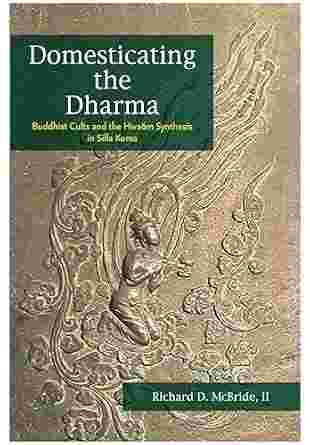
Domesticating the Dharma
Why read this book?
Richard D. McBride, II attacks two historiographical habits that distort the history of Silla Buddhism: narrating its development as a sequence of doctrinal “schools,” and separating an elite, intellectual religion from a “popular” Buddhism of cults, miracles and ritual. His argument is sharper: learned monks, royalty and aristocrats themselves worshipped Maitreya, Avalokiteśvara and Amitābha, commissioned images, recited dhāraṇīs, performed repentance and sponsored protective rites.
For art history, the payoff is immediate. Statues, monasteries, pagodas, mountain sanctuaries and architectural programs are not secondary illustrations of doctrine; they are instruments of legitimation, protection, merit-making and territorial transformation. The book shows how Silla was progressively recast as a Buddhist land and then interpreted through Hwaŏm cosmology.
What the book helps us understand
- The elite/popular model does not hold.Practices often labeled “popular” — image worship, miracle traditions, dhāraṇīs, recitation and repentance — were also performed and promoted by eminent monks, royalty and aristocrats.
- Cults explain religious history better than “schools.”Maitreya, Avalokiteśvara and Amitābha were not sealed traditions. Their practices overlapped, interacted and were gradually absorbed into a Hwaŏm framework.
- Hwaŏm was a practice as well as a doctrine.For Ŭisang and his successors, the Avataṃsaka Sūtra organized recitation, devotion, repentance, bodhisattva cults, state protection and the path to awakening.
- Silla’s territory became a Buddhist landscape.Mountains, monasteries and older sacred places were reinterpreted as traces of buddhas, abodes of bodhisattvas, or Korean counterparts of sacred sites in China and India.
Contributions to art history, Buddhism and Asian history
For art history, Richard D. McBride, II directly connects iconography, architecture and practice. Images of Maitreya or Avalokiteśvara could be commissioned to obtain a son, protect a family, generate merit or stabilize political authority. Hwangnyongsa, Pulguksa, Sŏkkuram, Odaesan and Naksan become case studies in which form, ritual and territory must be read together.
For Buddhist studies, the book restores practice to the center. Buddhism on the ground in Silla appears as a repertoire of recitation, visualization, image worship, offerings, divination, repentance, dhāraṇīs and state rites rather than the local application of imported doctrinal systems.
For Asian history, the study places Silla within a connected sphere linking the Chinese Northern dynasties, Tang China, Koguryŏ, Paekche and Japan. Transmission involved not only ideas, but rituals, models of rulership, images, institutions and ways of sacralizing space.
Sites, monuments, works and people to remember
- HwangnyongsaA major royal monastery in Kyŏngju, tied to royal legitimation, state-protection rituals and the famous nine-story wooden pagoda.
- OdaesanA Korean reconfiguration of Mount Wutai: the mountain became a Hwaŏm ritual center where deities of the Avataṃsaka Sūtra were invoked for the protection of the kingdom.
- NaksanA site associated with Avalokiteśvara on Silla’s east coast, materializing the transplantation of Buddhist sacred geography into the Korean landscape.
- PulguksaA complex Richard D. McBride, II reads as a spatial synthesis of several cults within a Hwaŏm horizon, bringing Vairocana, Avalokiteśvara and Amitābha into one ritual environment.
- SŏkkuramAn artificial grotto whose central Buddha has been variously identified as Śākyamuni, Amitābha or Vairocana; Richard D. McBride, II favors an inclusive reading compatible with Hwaŏm.
- ŬisangA central figure in establishing Hwaŏm in Silla, linking the Avataṃsaka Sūtra to concrete practice and a network of monasteries.
- WŏnhyoA major exegete whom Richard D. McBride, II refuses to confine to a single “school”; he exemplifies the intersection of exegesis, Hwaŏm, devotion and wider preaching.
- Maitreya and AvalokiteśvaraTwo cults crucial for understanding Silla art, devotion and religious politics: the former strongly tied to hwarang and elites, the latter developing into a broadly accessible savior cult.
The author’s thesis
The successful domestication of Buddhism in Silla was driven first by the adoption and promotion of Buddhist cults by social and religious elites. The cults of Maitreya, Avalokiteśvara and Amitābha were subsequently reorganized within Hwaŏm, whose cosmology could integrate ritual practice, images, political protection and the sacralization of territory. “Popular Buddhism” was therefore not a lower stratum of religion; it largely describes the mainstream Mahāyāna Buddhism practiced by elites as well.
What this book changes in our understanding
After Richard D. McBride, II, it becomes difficult to present Silla Buddhism as a sequence of doctrinal systems imported from China and arranged into separate schools. The same monks appear as exegetes, ritualists, devotees and political actors; the same cults cut across social and doctrinal categories.
The second shift concerns space. Buddhism did not spread only by introducing new texts or images: it transformed geography. Monasteries, mountains, grottoes and older sacred places were reinscribed into a universal Buddhist past. Hwaŏm then provided a powerful language for presenting Silla not as a periphery, but as a genuine land of the Buddha-Dharma.
Limits of the book
Who is this book for?
Verdict
The book’s real strength is its move from “what Buddhists thought” to “what they did, funded, built and worshipped.” For research on Silla Buddhist art, Hwaŏm or the sacralization of the Korean landscape, it offers an exceptionally productive framework, provided its reliance on late literary sources is kept in view.